


The number of unhealthy air quality days caused by wildfires are increasing across Oregon. In 2020, those living here experienced the worst air quality ever recorded in the state.
These conclusions come from Oregon DEQ’s recently released “Wildfire Smoke Trends and the Air Quality Index” report, which tracks wildfire-related air quality trends in 24 Oregon communities. It uses information from DEQ’s Air Quality Index, which calculates potential health impacts from the primary pollutant in wildfire smoke known as fine particulate matter, or PM 2.5. These very small particles can be inhaled deep into the lungs and cause coughing, chest pain and asthma attacks, and can increase risks for heart and lung disease.

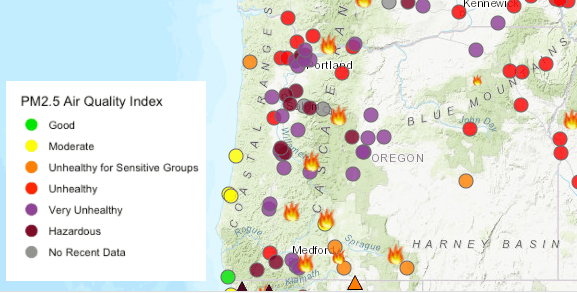
“Wildfires are becoming larger and more frequent across the Western U.S., which is causing more smoky days with poor air quality,” said Ali Mirzakhalili, DEQ’s Air Quality Division administrator. “Increasing wildfire smoke from Oregon, as well as California, Idaho, Washington and even British Columbia, means more communities across the state are now experiencing higher concentrations of PM 2.5.”
Air quality is listed by category as follows: “Good,” “Moderate,” “Unhealthy for Sensitive Groups,” “Unhealthy,” “Very Unhealthy” and “Hazardous.” Sensitive groups are children, adults over 65, pregnant women and people with medical conditions. While the report highlights smoke and air quality in four locations – Bend, Klamath Falls, Medford and Portland – you can also find data on 20 additional sites throughout the state.
The data shows some concerning trends. Key findings include:
- Historically, wildfire season begins in late July and continues into early September. By that standard, the 2020 season was shorter in duration than years past, but more intense. Concentrations of PM 2.5 measured higher during September and October 2020 than any other time since DEQ began monitoring air quality in 1985.
- Overall trends indicate that the number of days in which air quality measures “Unhealthy for Sensitive Groups or Worse,” as well as concentrations of PM 2.5, are continuing to increase.
- Between 1987 and 2014, Bend had three “Unhealthy” days caused by wildfire smoke. However, between 2015 to 2020, Bend experienced 13 “Unhealthy,” five “Very Unhealthy” and six “Hazardous” days.
- Klamath Falls had 20 “Unhealthy” days from wildfire smoke before 2015, but 37 “Unhealthy” days between 2015 and 2020. In addition, Klamath Falls had only two “Very Unhealthy” days before 2015, but five between 2015 and 2020. The area also experienced its first “Hazardous” day in 2020.
- Medford had 18 “Unhealthy” days between 1985 and 2014 and 46 between 2015 and 2020 from wildfire smoke. It endured nine “Very Unhealthy” days between 1985 and 2014. From 2015 to 2020, Medford also had nine “Very Unhealthy” days. The same area had one “Hazardous” day in 1987 and then again in 2017. It experienced three “Hazardous” days in 2020.
- Before 2020, the Portland area had never experienced air quality measuring higher than “Unhealthy” on the AQI. However, last year the area logged three “Very Unhealthy” and five “Hazardous” days.


As the trends indicate, smoky days are becoming a part of life in Oregon. It is imperative people are mindful of and prepare for these events. DEQ recommends using information and outreach tools available online through the Air Quality Index, the free OregonAir smartphone app and the Oregon Smoke Information Blog. You may also sign up for air quality advisories. In addition, the Oregon Health Authority provides resources and guidance as to how to protect your health when you are among wildfire smoke.
You may read the entire report here. Stay safe!
By Susan C. Mills, public affairs specialist