Share your passion for art and climate awareness by submitting your original artwork to the Oregon Department of Environmental Quality. Your artwork will help us highlight the impacts of climate change on Oregon’s youth. during policy discussions. It may appear in DEQ’s Climate Action Plans, on the agency’s website, in presentations, and on social media platforms —reaching audiences statewide.
The contest theme is: From Pollution to Solution – the Earth We Want to See. Submit your artwork by April 22, 2026, and share your vision for Oregon!
Climate change is significantly impacting Oregon’s present and future. We want to see your unique perspective —share your experiences, concerns, and solutions through visual art.
The first 100 students to submit artwork will receive a $30 electronic gift card! Plus, you’ll also be entered in a raffle for a special lunch with DEQ’s Director, Leah Feldon. This is a great way to showcase your artistic talent and experience living in Oregon.
Help us spread the word! Join us in making a difference! If you work with youth, schools, or community organizations, please share this exciting opportunity and inspire even more students to get involved.
Investments will reduce greenhouse gas emissions in Oregon communities.
“We’ve seen this firsthand in the Rogue Valley, where communities affected by the 2020 Alameda Fire are still struggling to rebuild. This is why today, more than ever, all Oregonians need programs like the community climate investments to reduce the after-effects of pollution and other toxic greenhouse gases for our vulnerable populations.” —Metzin Rodriguez, Unite Oregon
This process may approve one or more third-party entities to receive investments and implement projects that reduce greenhouse gas pollution in Oregon’s communities. Applicants must be certified to do work in Oregon and must be 501(c)(3) non-profit organizations, but subcontractors or partners working with an applicant can be for-profit organizations.
Photo (left to right):Sanne Stienstra, Joan Grimm (former DEQ staffer), Rita Haberman, Amanda Ingmire, Anne Gire (Oregon Building Codes Division)
Rita Haberman, a Built Environment Specialist in the Materials Management Program, was recently awarded the Women of Vision Award from the Daily Journal of Commerce. The Women of Vision award recognizes women in the region who are shaping the built environment with their technical skill, leadership, mentoring, community involvement and the creation of opportunities for the future generation of women in the industries.
A display of native made baskets, tools, beadwork, and First Foods, laid out on a large tule mat, provided by Caretakers of the Land.
This fall, DEQ staff joined over 70 others in a multi-day Carbon and Culture Symposium, hosted by the Confederated Tribes of Umatilla Indian Reservation (CTUIR) First Foods Policy Program. After two years in the making, their idea of a gathering focused on Indigenous land stewardship and carbon management came to fruition in the beautiful setting of Cove, Oregon.
DEQ’s Making Waves Water Quality Conference held at the Tiffany Center in Portland.
I had the pleasure of attending DEQ’s water quality conference, Making Waves: Collaborating for Clean Water in September. As a someone still relatively new to the agency, this conference sounded like the perfect environment for me to learn more about DEQ’s work statewide in protecting water quality, meet the many people who champion that mission, and reflect on how I could better serve my team members.
On the weekend of Sept. 13th and 14th, 11 DEQ staff members joined organizations from across the city and state at the Oregon Museum of Science and Industry to celebrate ScienceFest, OMSI’s annual celebration of scientists, engineers and innovators who are inspiring future generations. DEQ was one of dozens of vendors, ranging from assistive living technology companies to mermaids, that set up at tables and event spaces throughout the grounds. OMSI reported more than 4,300 visitors attended the event this year.
DEQ staff set up a welcoming place to attract ScienceFest attendees for conversation and learning.
On Saturday, Valerie Arkell and Andrea Matzke from DEQ’s Water Quality Division shared information about the state of Oregon’s water and waterways and made water-themed magnets with the children that stopped by. Tiffany Mosher from DEQ’s Lab set up one of DEQ’s own SensORs and demonstrated how it monitors air quality in Oregon. Meanwhile, Justin Haynes, Henry Moormann and Marjorie Hay from the Vehicle Inspection Program shared information about Oregon’s air quality and how it connects to the vehicles on the road and the work they do at the VIP stations.
“The crowd was so engaged and enthusiastic,” remembered Chris Varley, “I don’t think there was a moment all day when I wasn’t in conversation with someone.”
DEQ’s Chris Varley and his kids hanging out at the ScienceFest.
On Sunday, Susan Mills and Chris Varley hosted a memory matching game about the criteria pollutants that make up the Air Quality Index, all while promoting DEQ’s own OregonAir app to connect residents with the most local and accurate information about the state of Oregon’s air. Edgar Arellano and Tu Thuy, consultants from Erica Timm’s Oregon Clean Vehicle Rebate Program chatted with visitors in both English and Spanish and shared resources connecting them to opportunities to receive money back when the buy or lease an electric vehicle.
“It was really fun being in such a pro-science environment. I loved connecting with the community, especially with the kids, and sharing all the great work DEQ does for the people of Oregon,” explained Susan Mills.
“The crowd was so engaged and enthusiastic,” remembered Chris Varley, “I don’t think there was a moment all day when I wasn’t in conversation with someone.”
Keep an eye out for Oregon DEQ at next year’s OMSI ScienceFest and other public events across the state.
Key Takeaways from the OASIS 2025 Summer Symposium
2025 OASIS intern symposium
Marina Thompson worked with Ashland Food Co-op where she conducted a waste stream audit to help the Co-op reach their zero waste goals.
Camiron Coco worked at the Rogue Creamery on projects that involved waste audits, emissions tracking, and water reduction strategies.
Abigail Williams (right) worked at Revino identifying new beverage manufacturers interested in reusable glass, and evaluating environmentally preferred chemical wash practices to improve reuse safety and efficiency.
Rohan Keenan worked on a water mapping project for the Oregon Potato Company.
Carlos A Rodarte worked at BRING
and focused on energy efficiency in refrigeration.
Robyn Henry worked with the Eugene-based nonprofit BRING Recycling and focused on supporting Food & Beverage Manufacturers in improving refrigeration system efficiency and reducing refrigerant leaks.
Gillian Rutten working at the Oregon Garden to improve the efficiency of the garden’s greenhouse.
Sage Henke worked at Chapul Farms, an innovative agricultural startup in McMinnville.
The Oregon Applied Sustainability Internship (OASIS) program held its highly anticipated Summer Symposium recently, where eight talented interns delivered presentations showcasing their projects aimed at enhancing sustainability for Oregon businesses. You can hear directly from the interns in this 2025 OASIS program video.
Over an intensive 11-week period, upper-level undergraduate and graduate students from universities across Oregon including, the Oregon State University, University of Oregon, Southern Oregon University, Linfield University and Lewis and Clark College, participated in the paid internship program. The interns worked for both small and large businesses in the state’s food and beverage industry. They showcased a variety of practical projects, each designed to make a real difference in pollution prevention and resource efficiency.
Here are some highlights from their impactful work this year:
Comprehensive Water Mapping: Rohan Keenan designed a comprehensive water mapping project aimed at improving operational efficiency and creating a model that can reduce water usage across multiple plants.
Energy Optimization for Small Manufacturers: Robyn Henry and Carlos A. Rodate provided technical assistance and developed training materials for small food and beverage manufacturers like coffee roasters, bakeries, grocery stores and breweries to optimize refrigeration systems to reduce energy costs.
Path to B-Corp Certification: Camiron Coco supported a local creamery in pursuing B-Corp Certification by implementing waste audits, enhancing data management practices and suggesting water efficiency equipment.
Life Cycle Assessment for Organic Soil Amendments: Sage Harris collected data for a Life Cycle Assessment analysis to identify strategies that eliminating byproducts generated during the production of organic soil amendments from black fly larvae.
Reusable Wine Bottle Programs: Abigail Williams worked for a startup aiming to introduce reusable wine bottle programs to wineries; researching methods to reduce toxic chemicals in the bottle-washing process and conducting outreach to attract new customers.
Energy Efficiency: Gillian Rutten recommended a strategy to replace outdated heaters with electric or propane units in a garden greenhouse, boosting overall energy efficiency. An additional recommendation was to build a compost water heater to expand effluent water use.
Waste Reduction at a Local Co-op: Marina Thompson improved food and solid waste management at a local food co-op, emphasizing the value of reusable containers at the hot bar and deli while improving packaging and purchasing policies.
DEQ Senior Toxic Reduction Analyst and OASIS Program Administrator, Lisa Cox, is passionate about the program’s overarching mission and says, “through OASIS, we’ve been able to provide free technical assistance to many businesses across the state. Our goal is to help them achieve their environmental objectives while supporting pollution prevention solutions and environmental workforce development.”
Interns benefited from the guidance of mentors and industry professionals, including engineers, sustainability experts, and scientists. At the end of their internships, they proposed actionable solutions that companies could implement to tackle identified challenges.
Based on the interns’ recommendations, if implemented, businesses could potentially save the following amounts annually:
• 3,497 pounds of solid waste • 2,669.785 metric tons of CO₂ emissions • 1,320 pounds of hazardous waste • 85,516 kilowatt hours of energy • $287,649 in costs • 7,720,000 gallons of water
Stay tuned for the next OASIS program.
By Yulia Shipulina, DEQ Pollution Prevention (P2) Program Coordinator
2025 marks a significant milestone for paint product stewardship in Oregon. The Oregon Department of Environmental Quality and the Paint Stewardship Program are celebrating 15 years of operation. The stewardship organization, PaintCare, has successfully collected 10 million gallons of leftover paint in Oregon. This achievement is important because leftover paint makes up the largest volume of materials collected by local household hazardous waste programs. It is estimated that 10% of the more than 7.5 million gallons of architectural paint sold each year in Oregon goes unused.
PaintCare’s stewardship aims to increase opportunities to manage leftover paint properly, offering convenient disposal locations throughout the state where households and businesses can drop off their leftover paint free of charge.
As of July 1, 2025, the Oregon Paint Stewardship Program has accomplished the following:
Oregon Gov. Tina Kotek proclaimed Sept. 15-19 to be SepticSmart Week this year, adding to the national awareness campaign to bring attention to the importance of septic system care and maintenance for public health and safety.
“By making efforts to educate the public about septic systems and onsite wastewater Oregonians can achieve the highest possible standard of safe, sanitary and environmentally sound onsite wastewater service,” reads part of Kotek’s Aug. 18 proclamation.
DEQ is taking part in the national campaign and spreading SepticSmart Tips. Our septic DO’s and DON’Ts underscore the messages of the week.
SepticSmart Week has been around since 2013, so this year marks its 13th anniversary. The U.S. Environmental Protection Agency launched the annual event to help homeowners, communities, and local governments understand the importance of maintaining septic systems.
The EPA offers these tips to be #SepticSmart:
Think at the Sink! Learn what not to put down your kitchen sink (such as fats, oils, or greases), properly dispose of food waste and how to use cleaning supplies in moderation.
Keep It Clean!Don’t Strain Your Drain! Learn about the importance of testing your well water, and its relationship to your septic system.
Shield Your Field! Learn about your septic system’s drainfield, including how it works, and tips to take care of it.
Protect It and Inspect It! Learn about a typical septic system inspection, how often an inspection should be performed and considerations for advanced systems.
Don’t Overload the Commode! Learn about what can be flushed down the toilet, and what should be thrown in the trash.
Pump Your Tank! Learn about a typical septic tank pump-out service, and how a septic tank works.
Application period for clean truck and infrastructure grants extended through Sept. 3
Oregon DEQ grants and incentives can help develop electric vehicle charging stations for medium- and heavy-duty vehicles.
ATTENTION DIESEL FLEET AND EQUIPMENT OWNERS! You can apply for a variety of grants to support efforts to reduce dirty transportation emissions across the state through Oregon DEQ’s 2025 Clean Trucks and Infrastructure program.
Photo caption: Climate planners board the electric school bus that was generously offered as transport from Beaverton School District.
Climate planners came together in Portland this July to continue learning from one another, building momentum for collaboration, and charting paths forward for this work even in uncertain times. Oregon did not disappoint. The gathering began with a field trip to visit two inspiring local projects. Attendees hopped on a Beaverton School District electric school bus to head over to the first stop, Verde’s community solar project in NE Portland.
The first community solar project of its kind in the area, located on Port of Portland land, provides clean energy to 200 BIPOC and elderly residents in the Cully neighborhood. This initiative not only delivers clean energy but also lowers utility bills, benefitting the community economically. Saolo from Verde highlighted the importance of bringing in community members at the earliest stages of dreaming up the project. Verde serves communities by building environmental wealth through social enterprise, outreach, and advocacy. Funded by the Portland Clean Energy Fund, this pilot project will inform future projects will break ground soon.
This is just the beginning of the incredible work happening around the country aimed at reducing climate pollution and strengthening community.
Photo caption: Saolo, from the Verde Builds team, shares how the community engages with the project through planting native plants and taking care of the land surrounding the solar panels.
The crew set off again to Portland General Electric and Daimler’s joint vision, Electric Island, to get a behind-the-scenes look at what it takes to charge electric heavy-duty trucks. This site is unique in that it allows for testing of a variety of electric vehicle chargers that are on the market today. From how the electricity makes its way from the grid to the site and then to the chargers and vehicles themselves, this site is constantly collecting lessons on how to improve future sites.
Photo caption: Daimler staff gave a behind-the-scenes look at how Electric Island functions for charging electric vehicles of all sizes.
The field trip was followed by keynote speakers and collaborative workgroups that addressed critical ways to reduce greenhouse gas emissions. Plenty of time was also left for sharing out from many states that are doing incredible work to address climate pollution.
Michigan is running a Justice 40 Accelerator Program, a cohort-based program for community-based organizations from Michigan’s Justice40 communities to receive technical assistance and training to apply for and receive available funding successfully. Colorado is tackling industrial decarbonization projects through grants for industry-related emission reduction projects that bring the State closer to its air pollutant emission reduction goals. New Jersey is set to launch a one-stop shop, enabling residents to use to find all rebates and programs in the State to reduce climate pollution. New Orleans came together after Hurricane Ida and dreamt up the Community Lighthouse, powered by solar and storage, a gathering place in each community where neighbors can come when they lose power during extreme weather events. This is just the beginning of the incredible work happening around the country aimed at reducing climate pollution and strengthening community.
…learning from one another, building momentum for collaboration, and charting paths forward for this work even in uncertain times.
Last, but not least, the inspiring speakers from Portland Clean Energy Fund and Vertue Lab left the group with hope and an exploration of what it means to be resilient during difficult times.
Wildfire season is here and one of the best tools to keep Oregonians informed about how wildfire smoke affects air quality is the Oregon Smoke Blog. This blog is hosted by the Oregon Department of Environmental Quality and provides near real-time air quality information gathered from 40 monitoring sites positioned around the state.
Left to Right: Brenda María Trejo Rosas (Agency Environmental Justice Coordinator, Office of Equity); Renee Trexler (VIP Station Operations Manager); Hillarie Sales (Air Quality Program Coordinator); Chris Varley (Air Quality Public Affairs Specialist) and Valerie Arkell (Water Quality, Basin Specialist).
On April 23, the Oregon Department of Environmental Quality joined organizations from across the state. They gathered at the Oregon Museum of Science and Industry (OMSI) to celebrate Pacific Northwest Forests at the OMSI After Dark event in Portland, Oregon. The event drew hundreds of Portlanders eager to engage with the exhibits and organizations and to celebrate the natural wonders of the forests for the 55th anniversary of Earth Day!
(Left to right: Tribal representatives Mary Lou Soscia and Lindsay McClary, DEQ’s Cat Rhoades)
DEQ recently partnered with the Confederated Tribes of Grand Ronde and the Oregon Department of Agriculture to host a pesticide and household hazardous waste collection event. The events took place on April 11 and 12 in Grand Ronde. Both the Tribe and DEQ are recipients of EPA’s Columbia River Basin Restoration Funding Assistance Toxic Reduction Lead grants, which support environmental protection and restoration programs throughout the Columbia River Basin.
On May 9, DEQ Director Leah Feldon, celebrated Public Service Recognition Week nominees during the Oregon Environmental Quality Commission meeting in Bend, Oregon. This year, DEQ selected three Public Service Ambassadors: Amanda Ingmire, Kara Master and Erica Timm out of a total of eight nominees.
Today, as we celebrate Earth Day, I encourage everyone to take a moment to reflect on the beauty of our planet in all its diverse, interconnected and natural wonder – we really do live in a remarkable place.
I hope you will connect with nature today, whether that means taking a walk in a park, spending time in your garden, or engaging in any other outdoor activities. I find moments like these incredibly grounding and calming.
At DEQ, we are all stewards of the environment. We each have a role in protecting Oregon’s natural resources and ensuring healthy air, water, and land for future generations. Our actions, whether big or small, truly matter. Whether it’s our work to reduce air emissions, restore pollutant-impaired waters, or address past contamination or promoting sustainable practices, we collectively contribute to a healthier environment that benefits everyone.
Our planet, DEQ and people in Oregon have all shown remarkable resilience in the face of increasingly complex environmental challenges. Let this day inspire us to take even greater steps, both personally and professionally, to advocate for a healthier environment for everyone.
Thank you for all the hard work you do every day to make our planet a better place. Thank you for being stewards of the environment.
For the fourth year in a row, Oregon leads the way nationally throughout Food Waste Prevention Week, April 7-13, 2025. This annual campaign brings together communities, businesses, schools, and individuals to tackle food waste through education, action, and celebration.
This plan outlines the three key priority areas for DEQ’s future work in food systems: Sustainable Food Production, Sustainable Food Consumption and Sustainable Food Waste Management.
Photo: DEQ’s Material Management Program Food Systems Team
Sustainable Food Production: Supporting lower-impact agricultural and food production practices, including those that reduce chemical inputs, sequester carbon, and improve soil health. This includes exploring opportunities to support small-scale and community-based food production.
Sustainable Food Consumption: Preventing food waste while increasing food access, supporting localized food systems, and promoting lower-impact dietary choices in collaboration with health and nutrition partners.
Sustainable Food Waste Management: Improving food waste recovery through composting and anaerobic digestion, with a focus on leveraging organic material to enhance soil health, reduce reliance on chemical fertilizers, and generate renewable energy.
Webinar April 30: Learn more about Reducing Food Impacts: A Strategic Plan for Oregon and how the Food Action Plan will translate the vision into action. Register here to attend on April 30 at 11 a.m.–12 p.m. (PTD).
Yulia Shipulina has joined the Department of Environmental Quality as a temporary fellow, in partnership with Oregon Sea Grant, to further develop our pollution prevention, or P2, projects in DEQ’s Land Quality Division.
The P2 projects she’ll work on are funded by the U.S. Environmental Protection Agency and managed by Lisa Cox, our Senior Toxics Reduction Analyst.
DEQ’s P2 initiatives include:
P2 Internship Program: Since 2017, 40 businesses have offered free internships, helping students gain experience while saving water and money.
Food and Beverage Outreach: We’ve assisted 15 businesses in reducing waste and improving practices with financial support.
Safer Choice Certification: We helped 15 businesses get certified and added five safe chemicals to our approved list.
With experience in marketing, graphic design, and event coordination, Yulia is eager to help businesses become more sustainable and promote pollution prevention by working with schools to cut toxic chemicals in labs, writing newsletters, updating our website, and supporting interns. When she’s not working, she’ll likely be dancing and learning about different cultures.
She’s excited to have the opportunity to gain vital career experience while helping to protect human health and the environment. And we’re thrilled to have her on board.
Oregon DEQ Director Leah Feldon speaks at OMSI about 100,000 state-registered EVs.
This past summer, Oregon got a big boost in its efforts to achieve a greener future when the state surpassed 100,000 registered electric vehicles. Oregon DEQ celebrated the major milestone with the Oregon Departments of Transportation and Energy and the Oregon Museum of Science and Industry at a media event on Nov. 18.
Directors from each agency and the president and CEO of OMSI spoke about the state’s progress to electrify transportation and reduce air pollution from transportation, which accounts for about 35% of the state’s total greenhouse gas emissions. Other event attendees included State Senator Janeen Sollman, a representative from Sen. Aaron L. Woods’ office and members of Portland electrification nonprofit Forth.
As Veterans Day approaches, I ordinarily take this time to reflect on my military service, its influence on my life journey and where I am today. This will be my second Veterans Day since separating from the Air Force and my first Veterans Day at DEQ. Although I often measure periods of my life by milestones and patterns of cause-and-effect, the influence of effective leadership is a recurring theme in nearly all aspects of my personal and professional life.
Community Air Action Planning, or CAAP, is a new pilot program led by DEQ’s Air Quality Division. This pilot program takes a place-based approach to improving communities’ air quality knowledge and capacity for collective action. DEQ worked with a steering committee of advocates, community-based organizations, and state and local government representatives to design the program’s framework.
EUGENE – Oregon DEQ Director Leah Feldon on Tuesday joined Casey Sixkiller – U.S. Environmental Protection Agency Region 10 Administrator – to celebrate milestones for the J.H. Baxter cleanup in west Eugene.
Earlier this month, the EPA proposed the addition of J.H. Baxter to the Superfund National Priorities List. This past June, DEQ finished the cleanup of seven residential properties north of the facility, a wood treatment plant that had been in operation from the early 1940s until 2022. Dioxins leaked from the facility contaminated nearby yards.
“These contaminated yards were where people gardened, and children played,” Feldon said. “The people living at these seven properties can now feel safe spending time in their yards again.”
Funds will advance Oregon’s efforts to meet climate goals
DEQ Director (center) and members of DEQ’s Office of Greenhouse Gas Programs celebrate with Karin Power Natural Resources and Climate Policy Advisor for Gov. Tina Kotek (fourth from left) at the Governor’s press conference. (Left to right) GHG Program Manager Colin McConnaha, Climate Pollution Investments Coordinator Morgan Schafer, Director Leah Feldon, Karin Powers and Climate Policy Community Engagement Coordinator Whitney Dorer.
On July 22, 2024, the U.S. Environmental Protection Agency announced the State of Oregon will receive $197 million from the federal Climate Pollution Reduction Grant program.
Oregon Department of Environmental Quality Director Leah Feldon said, “This is an immense honor and demonstration of trust from EPA to provide so many resources to our state. Led by DEQ’s Office of Greenhouse Gas Programs, this work was a multi-media and multi-agency effort to address climate change across Oregon.”
It’s a phenomenon that features amazing colored light displays that reminds us the world is beautiful and full of wonder. The Northern Lights, officially known in the Northern hemisphere as Aurora Borealis, are produced by millions of explosions of magnetic energy.
In May 2024, the lights danced around the Pacific Northwest skies in dazzling hues. If you didn’t get a glimpse, here are a few stunning displays from DEQ staff that capture the beauty of the Aurora Borealis.
There aren’t too many things like witnessing the Aurora dance across the sky with your own eyes over Trillium Lake, OR, by Brad S., DEQ’s Western Region Cleanup Program Manager.Phil D. said he had an “Epic night!” Not only did he catch the Pearl Jam concert at the Moda Center, he caught nature’s light show after walking home. Phil is DEQ’s Northwest Region Petroleum Cleanup Section Manager.Stephanie S. took a few photos at the view point around I-84 mile marker 24 – River Highway Historic Point. Stephanie is the Fuels Sector Reporting Specialist for the Office of Greenhouse Gas Programs at DEQ Headquarters. Stephanie S. took this shot of the Northern Lights near Rooster Rock State Park. Stephanie is the Fuels Sector Reporting Specialist for the Office of Greenhouse Gas Programs at DEQ Headquarters. The colors of the northern lights vary: Here, blues, purples, maroons, greens and other hues paint the night sky. Tina E., Springfield, OR 2024. Tina is the Cleanup Project Manager for the Western Region Environmental Cleanup Program. Annie R. was on the beach when she saw the mesmerizing Northern Lights. Annie is a public affairs specialist for the Cleanup Program at DEQ Headquarters.Beth M. took this dramatic photo in Lake Oswego at the top of a hill. Beth is the Water Quality General Permit Coordinator at Headquarters.Even alone, seeing the northern lights is a memorable experience, but it’s special to share the moment with a friend — even if it’s not in Oregon. Andrea M. shared her son’s view from St. Olaf College in Northfield, MN. Andrea is the Lower Willamette Basin Coordinator/Watersheds Team Lead, DEQ Northwest Region.
A unified response of federal, state and local agencies are worked to track and cleanup a tar-like substance impacting shorelines and wildlife from Moclips, Washington, south to Waldport, Oregon, in late May and early June 2024. The source is not yet known.
Discolored water on May 6, 2024, along Perrydale Road in Perrydale, a community in Polk County, Oregon. / Photo by DEQ
Perrydale – DEQ and the U.S. Environmental Protection Agency are responding to the aftermath of a barn fire in Perrydale on May 2 that has caused red-colored water to flow through ditches in the Polk County community.
Photo caption: DEQ Director Leah Feldon and members of the Leadership Team and United Way present Carol Thornberg (center), Air Quality Division Executive Support Staff, with an award for her success as the agency’s volunteer coordinator for the Employees’ Charitable Fund Drive.
DEQ’s Carol Thornberg is a true champion of the agency’s values, such as public service, employee growth, teamwork, and excellence. As the volunteer coordinator for the Employees’ Charitable Fund Drive, Carol’s contributions were instrumental in achieving our fundraising success. DEQ raised an impressive $27,780 for the Heart of Oregon, a leading nonprofit organization dedicated to empowering and supporting youth in Central Oregon, making DEQ the top fundraiser in our agency size category.
That’s right! The Oregon Clean Vehicle Rebate Program has reopened for two months this year. Right now is the time for those living in Oregon to purchase or lease an eligible new or used battery electric or plug-in hybrid electric vehicle or a new zero-emission motorcycle and get money back. However, there are important details you should know before you head out to your local dealership.
So, for this month’s episode of GreenState, DEQ’s Dylan Darling and Susan Mills met with the agency’s Oregon Clean Vehicle Program Coordinator Erica Timm to discuss all things electric vehicle rebates.
We asked Erica about the two rebates and how they differ. We inquired about when the program closing date is for this year and why (Spoiler, it’s June 3, 2024). We quizzed her on what the term “participating dealerships” means. But Erica has been working on DEQ’s rebate program for several years and knows it forwards and backwards. Tune in wherever you find your podcasts for the informative conversation.
Some regular listeners may remember we did two podcasts on the Oregon Clean Vehicle Rebate Program back in 2022 (Episode #8 and Episode #9). If you haven’t already, we encourage you to go listen to them. They provide a lot of the basic details on the rebates. Although, we also urge you to listen to this new episode. It has the latest updates, especially as they relate to the limited program opening this year – and we don’t want you to miss out on a fantastic rebate opportunity (while also reducing air emissions 😉).
Will you be getting money back on a new or used electric vehicle?
Tree planting in North Portland. Fines for air pollution violations have gone toward tree planting, which are among the projects that the community wanted to see. Photo courtesy Friends of Trees
For years, the Oregon Department of Environmental Quality has offered pollution violators the option to pay for environmentally friendly projects to partially offset assessed fines. Now the department is working to ensure communities have a role in deciding what projects these fines will fund.
A tank is replaced for a Clackamas County resident
Oregon’s Clean Water State Revolving Fund mission is to provide technical assistance and below-market rate loans for planning, design and construction projects that improve water quality and environmental outcomes. This program, managed by DEQ, helps protect public health, restore natural areas and promotes economic development statewide. Since the program began in 1988, communities all over Oregon have benefited from more than $1 billion in water infrastructure investments. In a the most recent annual report, DEQ executed 11 new loans through the Fund, totaling $19,521,500 between July 1, 2021 and June 30, 2022.
Since 2018, the Fund has helped the Clackamas Soil and Water Conservation District (CSWCD) expand their program and enabling critical septic system repair across Clackamas County. We asked our friend, Heather Nielsen, Conservation Investments Coordinator at CSWCD, to write about her experience working with DEQ and the Fund.
The CSWCD provides conservation services to people who live within Clackamas County. CSWCD works in cooperation with public and private land managers and owners as well as local community partners to conserve shared natural resources. Maintaining healthy streams and groundwater is a CWSCD priority which benefits the watershed and the public. Watershed protection in Clackamas County led CSWCD to provide two programs that help County residents who need to repair or replace part of their existing septic system: The Septic Repair Grant Program and the Residential Septic System Repair and Replacement Loan Program.
The Pacific Coast Collaborative recently released its Vision and Action Plan to promote a regional low-carbon construction sector that promotes equity-centered policies, job creation, and regional markets. Through the PCC, Oregon, British Columbia, Washington, California, and the cities of Portland, Vancouver, Seattle, San Francisco, Oakland, and Los Angeles are working together to build the low carbon economy of the future.
Homeowners, potential homebuyers, and renters, if you plan on renovating or demolishing a home in Oregon you need to think about asbestos – a natural mineral that might be in your building materials.
DEQ’s Hillarie Sales and Dylan Darling help make asbestos regulations relatable by talking with two inspectors from DEQ, and an Oregon Health Authority toxicologist explains why asbestos is a health concern in the first place.
A proper asbestos abatement project includes measures to protect workers and passersby from asbestos in the air.
“If you are planning on doing any renovation work then the concerns, they’re there,” said DEQ Asbestos Inspector Akim Williams. “You have to have testing done. You have to an abatement contractor remove that material in a safe manner.”
There is no known safe level of exposure to asbestos. This makes asbestos a serious health concern and subject to regulation by DEQ.
“The reason it’s a problem is because it’s a persistent mineral and because it is in the shape of a thin fiber,” said David Farrer, an Oregon Health Authority toxicologist. “In certain forms it can be like a very fine, invisible even, particle that you inhale. And because it is a long fiber and it doesn’t dissolve it gets stuck in your lungs and then your lungs can’t get rid of it.”
Oregon DEQ’s own Ximena Cruz Cuevas was recently appointed to the Environmental Protection Agency’s 2024 National Environmental Justice Advisory Council. She is the only member from the State of Oregon representing both State and Local government, on the 26-member council that includes representatives from a wide range of backgrounds, sectors, and experiences in environmental justice. The council will provide independent advice and recommendations to the EPA Administrator. Ximena says, “I’m excited about this opportunity at the federal level because I will be able to contribute even more to EJ work for DEQ and communities in Oregon.”
Photo: DEQ Director Leah Feldon, Angel Gillette, Zach Mandera and DEQ Lab Administrator, Lori Pillsbury celebrating graduation, Dec. 2023.
The Oregon Department of Environmental Quality is proud of Angel Gillette and Zach Mandera for recently completing the Leadership Oregon program, the executive leadership development program for the State of Oregon.
Leadership Oregon’s mission is to strengthen the professional and personal development of state managers, preparing them for leadership roles in state government. The Department of Administrative Services established the program in 1989.
Mattress are bulky and made up of layers of materials, including wood, steel and foam. This has made them a problem in landfills and a candidate for recycling.
GreenState podcast co-hosts Dylan Darling and Katie Romano visit a mattress recycling facility in Eugene to learn how the St. Vincent de Paul Society of Lane County pulls apart mattresses to keep most of material out of the waste stream. Terry McDonald, emeritus director for St. Vinnie’s led them on a tour and then sat down for an interview.
Terry McDonald, emeritus director of the St. Vincent de Paul Society of Lane County takes Dylan Darling and Katie Romano, co-hosts of the GreenState Podcast, on a tour of St. Vinnie’s mattress recycling facility in Eugene in September 2023. Photo by Joel Gorthy/St. Vincent de Paul Society of Eugene
“The industry average is about 75 to 80 percent (of a mattresses’ components) can be recycled in one form or another,” McDonald said. “That changes depending upon what the design of mattresses are.”
Rachel Harding, product stewardship specialist with DEQ, also joined GreenState to talk about the agency’s new Mattress Stewardship Program. In 2022, Oregon became the fourth U.S. state to enact a law establishing a statewide mattress recycling program and the program will ramp up in 2024.
“This is a brand new program for the state,” Harding said. “It’ll provide collection and responsible management of discarded mattresses throughout the state.”
The Oregon Department of Environmental Quality’s governing body, the Environmental Quality Commission, adopted six different sets of rules at their November meeting last Thursday and Friday.
Why do rules matter? Rules determine how DEQ regulates. When the legislature passes laws, they’re often very general. The agency responsible for implementing the law has to write the rules that include all the details. For more information on how rulemaking works, check out DEQ’s GreenState Podcast on this topic.
Food waste can cause a sour taste after the fun of holiday feasting.
So, GreenState podcast co-hosts Dylan Darling and Katie Romano catch up with two DEQ food waste prevention experts to learn how to better plan and shop ahead of holiday meals. The advice is good year round and taking on food waste is an easy way to help protect the environment.
Jerin Dinkins and Elaine Blatt offer up a buffet of tips, aimed at making you a better planner and shopper.
Dinkins joined DEQ about a year ago, bringing an interest and background in food education. “I’ve always been fascinated by the intersection of food in our society from the lens of environmentalism and from the lens,” she said in the podcast.
Blatt has been with DEQ for more than seven years and helps share food waste prevention advice throughout Oregon. “If you care about climate change, reducing your food waste is the easiest, simplest thing you can possibly do to combat the generation of greenhouse gases,” Blatt said. “And you can do it tonight at dinner. You can do it tomorrow at breakfast.”
For October, DEQ turns the spotlight on Matt Davis. Matt joined the agency in 2017 and served in several positions, including managing air quality teams in Headquarters and Northwest Region, and spending several years representing DEQ at the Oregon Legislature as a Senior Legislative and Policy Analyst. Last month, he was named as our permanent Policy and External Affairs Manager after serving in the position as interim since January.
You have been a fixture here for some time and worn a lot of hats, but for our readers who haven’t had an opportunity to work with you, what do you do here at DEQ currently?
As DEQ’s Policy and External Affairs Manager, I focus my time on supporting an amazing group of professionals responsible for budget development, communications, engagement with the Environmental Quality Commission, and government relations.. My day-to-day is extremely diverse – which is something I love!
What is your favorite part of working for the agency?
My favorite thing about working for DEQ is the DEQ’ers. Meeting people throughout the agency and learning about their work is so energizing to me. I have always been so impressed with the incredible skill, knowledge, passion, and care that people bring to their work at DEQ – be it at the lab, vehicle inspection stations, the regions and headquarters.
We also like to ask some questions about fun stuff too. Away from the office, what is your favorite hobby?
I LOVE motorcycles and motorcycling, but after a couple close calls and a baby, I traded my motorcycle in for an e-bike with a toddler seat. Exploring Portland with the wind in my face, and my daughter on the back is a new thrill that I’m fully embracing!
DEQ’ers are big on travel, so I have to ask, if you could travel anywhere, where would you like to go?
The Oyamel fir forests in Mexico, where Monarch butterflies migrate and roost every winter. Their multi-generational migratory journey is really awe-inspiring to me. I’d love to see it some day!
Lastly, if you could have any meal tonight, what would it be?
I’m a big believer that the best meals are those enjoyed in good company. I love feasting with my friends and family, no matter the cuisine. That said, oysters on the half-shell are never a bad thing.
I totally agree! Thanks Matt for taking the time to answer our questions. Stay safe on that bike!
Left to right is DEQ’s Lisa Cox with Pollution Prevention Resource Center’s Justin Meyers accepting the award form EPA’s Pollution Prevention Deputy Assistant Administrator Jennie Romer
The Oregon Department of Environmental Quality is honored to win the U.S. Environmental Protection Agency’s 2023 Safer Choice Partner of the Year award with the Pollution Prevention Resource Center for leadership in advancing safer chemicals and the EPA Safer Choice program.
A new voice to advance DEQ’s mission to protect, maintain and restore Oregon’s environment
The Oregon Senate confirmed Sept. 29 Governor Tina Kotek’s appointment of Eastern Oregon nonprofit director Mark Webb to the Oregon Environmental Quality Commission.
EQC Chair, Kathleen George said, “I am honored to welcome Mark and confident he’s a solid addition to our slate of commissioners. I look forward to incorporating his extensive experience and perspectives to advance the state’s leadership in environmental protection.”
Leah Feldon has a long history with DEQ – nearly two decades – starting in the Office of Compliance and Enforcement and later serving as deputy director.
The Oregon Environmental Quality Commission, which oversees DEQ, selected Feldon as the agency’s new director in February.
Director Feldon had a conversation with outgoing Communications manager Harry Esteve and GreenState Host Dylan Darling. Topics include Feldon’s thoughts on the direction of the agency, and how she wants to prioritize antiracism and environmental justice in its mission to protect and enhance Oregon’s environment and public health.
Note: Lauren Wirtis, an original co-host of GreenState is the new DEQ communications manager. She’ll still be on the podcast occasionally along with other co-hosts.
QUICK FACTS Date of incident: July 19, 2023 Location: 12350 NE Sandy Blvd., Portland Product: Ash and debris Unified Command: U.S. Environmental Protection Agency, Oregon Department of Environmental Quality, Portland Bureau of Emergency Management, Prologis (the building lessee)
For more than 20 years a pair of DEQ hydrologists have been sharing their knowledge of surface water and groundwater with outdoor school students in Eastern Oregon.
Laura Gleim, DEQ’s Eastern Region public affairs specialist, visited an outdoor school near Pendleton to learn along with the kids. She brought along a field recorder and a camera to document the trip. In Oregon, outdoor school is an opportunity for fifth or sixth graders to leave their classrooms and to learn in the outdoors, immersed in nature. This sort of education started in the late 1950s.
Outdoor school often takes place at residential camps, like classic summer camps. “It’s several days of the kids being out in nature, learning about soil and water, plants and animals, other environmental sciences and nature skills,” she said.
More than 150 people from federal, state, tribal, and local governments and BNSF Railroad convened at the Fort Dalles Readiness Center in The Dalles on June 13 to practice responding to a large-scale railroad oil spill. In the imaginary scenario, 23 tank cars carrying 540,000 gallons of crude oil derail along the Deschutes River near its convergence with the Columbia River.
The group’s goal: to develop and implement plans to quickly contain and clean up the imaginary spill to protect public health and minimize damage to the environment.
Sprawling pastures and desertscapes pop with various shades of spring green outside Burns in eastern Oregon’s Harney County—the state’s largest county by land mass but one of the smallest by population, at 7,515 people.
DEQ’s Eastern Region management team traveled from The Dalles, Klamath Falls, and Bend to meet with representatives from the cities of Burns and Hines, the Burns Paiute Tribe, and Harney County on May 23.
“I travel a lot over the mountains in my role,” said Harney County Judge Bill Hart, referring to the Cascade Mountains that spilt eastern from western Oregon. “I want people to come over here too—to see Harney County.”
QUICK FACTS Date of incident: June 7, 2023 Location: Milepost 45 on Highway 38 Product: Diesel and gasoline Cause: Tanker crash Unified Command: DEQ, ODOT and Western Hyway Oil
Status Updates
June 16, 2:30 p.m.
ODOT reported that Highway 38 was fully reopened Friday afternoon.
The roadway had been partially closed since June 7, when a tanker truck overturned and spilled fuel. Along with the cleanup being complete, the roadway has been repaved.
Staff from DEQ, EPA and Wild River Trust at the site of a former mill on which they conducted a brownfields assessment (March 2020)
U.S. Environmental Protection Agency recently announced seven sites in Oregon that will receive $8.2 million in brownfield funding for environmental assessment and cleanup projects. The grants will help transform the sites into community assets, attract jobs and promote economic revitalization. The following organizations in Oregon were selected to receive EPA Brownfields funding:
This week we turn our spotlight on Blair Adams at DEQ’s Laboratory in Hillsboro. Blair serves on DEQ’s Diversity, Equity and Inclusion Council and the Wellness Committee in addition to her regular duties. She also just won Oregon’s Public Service Award for 2023 in recognition of her efforts her at the agency.
Thunderheads loomed over the Cascades on an otherwise blue-sky day in Gates and Mill City, a reminder of the devastating September 2020 wildfires.
The cities are still rebuilding. New homes are going up among blackened trees and power tools echo in the distance, drowned out by the murmur of the river.
On Friday, May 19, members of the Oregon Environmental Quality Commission toured the canyon. They got an update from the North Santiam Watershed Council on water quality impacts, heard about local fire recovery and rebuilding efforts, and received an overview from Marion County and Mill City officials on plans for wastewater treatment projects.
Image: Air Quality word cloud created by 6th grade students at Sunny Wolf Charter School
DEQ Air Quality Monitoring Engagement Coordinator Hillarie Sales and Air Quality Coordinator Morgan Schafer have been working all year with a class of middle-schoolers at Sunny Wolf Charter School who have a great interest in science and learning more about air quality and hope to develop formal curriculum from this experience for other classrooms and the general public.
May is Wildfire Awareness Month,so we thought it a good idea to discuss air quality monitoring across Oregon, particularly during the summer season.
The Air Quality Index, air quality advisories and the Oregon Smoke Information blog are all great resources for people looking to understand what kind of air they’re breathing, especially if they’re planning to go camping, hiking or participate in any of the other outdoor activities people in Oregon love to do. DEQ works closely with various agencies and organizations across the state to understand and relay air quality information as accurately and timely as possible.
For Episode 22, we were thrilled to talk with DEQ’s Air Quality Monitoring Outreach Specialist Hillarie Sales and KGW 8 News’ Meteorologist and Reporter Chris McGinness about everything that goes into understanding air quality during Wildfire Season. In, addition, we discuss air quality advisories and some tips to plan for smoky air.
Former site of the Anderson Glacier, Quinault Drainage, Olympic National Park
Cherish Oregon’s land, water and air.
Beach and Nature.
Out with the old, an investment in planet earth.
Sunrise Over Trillium Lake
Tree watching over the beach
The Painted Hills of Oregon
Summer stroll at Sea Rock
What a wonderful world
Earthly Joys
The remarkable chemists
Peak water wealth
“Investing in Planet Earth” begins with inspiring a sense of wonder.
Trees and clean oceans help everyone
The votes are in. Our photo contest to celebrate Earth Month 2023 was a huge success. DEQers submitted a lot of great images as you’ll see in the slideshow above. The theme this year was “Investing in Planet Earth.” The images show the diversity of beauty in Oregon and why investment in our natural environment is so important.
Congratulations to our winners! Their photos and captions can also be viewed below. We also want to thank all of our staff who submitted photos. We hope to get even more next year.
Chris Modderman (left) and Peter Husted (center) record data in an air quality monitoring shed.
Oregon DEQ has released its 2019 – 2021 Air Toxics Summary, which provides data on air toxics that were monitored in nine locations across the state, including Bend, Eugene, La Grande, Medford and Portland. The goal is to measure air toxics across Oregon where people live, work and play. That way, DEQ and communities can make better informed decisions on how to track and reduce pollution and lessen exposure to harmful effects to protect public health.
This week we turn the DEQ staff spotlight on Megan Hendrickson. From our Eugene office, Megan works with organizations using funds to repair and replace septic systems in Oregon.
What is your favorite part of working at DEQ?
I started during the pandemic. The first three months were a blur of phone calls, Teams messages, and emails of me saying, “You don’t know me, but I have a question.” Folks in the agency consistently responded with pleasant surprise and made onboarding a lot of fun.
To celebrate Earth Month this year we are turning the spotlight on several staff across the state. This week, we talked with Ania Loyd. Ania is an air quality permit writer and inspector, working from the Eastern Region office in The Dalles.
What is your favorite part about working for DEQ?
There are many things I enjoy about working for DEQ. What brings me the most pride in my job is helping industries navigate regulatory requirements to bring better air for our community. I very much enjoy learning about various industry operations first-hand during inspections. Our state has so many interesting types of industry, from French fry producers, through metal casting operations, to biogas generation from landfills!
The theme for Earth Month 2023 is “Investing in Planet Earth” What does this mean to you?
Personally and through my work, I invest my time, expertise and finances to make our Planet Earth better for us and the future generations. I do my best to lower my household energy usage by driving less, using LED lights, participating in green energy and renewable natural gas programs and cutting down on unnecessary purchases. I also find it important to teach my kids about environmental issues and to foster their love for outdoors and nature.
Just for fun – If you could travel anywhere, where would you go?
I have to pick only one place? Currently, Japan is at the top of my travel wishlist. I’m hoping to plan that trip over the next year.
By Michele Thompson, DEQ Web Design/Business Applications and Graphics
Spoiler alert: Food waste is the second leading cause of greenhouse gases, which are a key ingredient in climate change.
But there’s something you can do about it in your home, starting at your next meal – food waste prevention. Katie, a DEQ communication and outreach specialist, joins Dylan on this episode to learn about food waste and life cycle impact. They’re joined by a DEQ expert and an environmental educator in Florida to talk about Food Prevention Week, which goes from April 10-16 in 2023. It’s the second year that the annual campaign has gone national.
We’ll offer some great, practical tips on how not to waste food, including an interesting trick with an egg.
April is Earth Month, and that’s a special time of year at the Oregon Department of Environmental Quality. We are the state agency dedicated to protecting the quality of Oregon’s abundant rivers and lakes, its spectacular landscapes and the air we all breathe. Whether we are studying water samples under a microscope, collecting data from one of our air monitors or performing emergency cleanup up after an oil spill, DEQ staff are actively investing in the health of our communities, our state and our planet.
Here are just some of the ways we invest in Earth:
DEQ is a science-based state agency, so it generates volumes of public records.
A team of two, with the support of 40 staff members, work together to guide our public record storage and response to requests. Along with discussing how and why DEQ stores records, the experts offer advice on how to best find what you need.
Dylan and Susan talk with Kristen Mercer and Leela Yellesetty to learn about public records. (Note, Lauren is filling in as a manager at DEQ, so she’s taking a break from GreenState.)
This is the most current information about DEQ’s response efforts at AmeriTies West in The Dalles, a railroad tie treatment plant where a fire started in a tank, causing an explosion.
QUICK FACTS Date of incident: March 9, 2023 Location: 100 Tile Plant Road, The Dalles Product: Diesel sludge and residue Cause: Under investigation
Status Updates
March 10, 5:30 p.m.
Air quality monitors installed early Friday afternoon are monitoring for particulate matter and volatile organic compounds, or VOCs.
People who breathed the smoke from the fire may have experienced coughing, wheezing, difficulty breathing, and/or irritation of the eyes, nose, or throat, according to the Oregon Health Authority. People over 65 and people with pre-existing heart conditions who breathed the smoke may be at increased risk of cardiovascular events for up to 24 hours after the smoke has cleared. Examples of cardiovascular events are coronary syndrome, arrhythmia, heart failure, stroke, and sudden cardiac death. People with asthma or other pre-existing respiratory diseases who breathed the smoke may have experienced worsened symptoms during the smoke event.
Cause of the fire is still under investigation, but emergency responders have learned that vapors inside the tank heated and expanded, causing an explosion inside the tank about 30 minutes after the fire started on Thursday night.
The damaged tank at AmeriTies West in The Dalles on March 10, 2023. Photo by DEQ
March 10, 3 p.m.
DEQ and EPA are monitoring air quality at the plant.
The tank normally contains a solution of 99 percent diesel and one percent copper naphthenate. Crews had cleaned the tank of that solution earlier Thursday, though some diesel sludge and sawdust remained in the tank.
Cause of the fire is still being investigated. The Sherriff’s Office reported that the two injured firefighters had been taken to the hospital and were in good condition.
Initial report – March 9, 2023
A fire was reported at 8 p.m. Thursday, March 9, 2023, at the AmeriTies West wood treatment plant in The Dalles. About a half hour later a tank exploded. DEQ, the U.S. Environmental Protection Agency, and other agencies are coordinating the response.
Two firefighters were injured when the tank exploded, according to the Wasco County Sherriff’s Office. DEQ reports that the tank underwent a BLEVE, or a boiling liquid expanding vapor explosion.
DEQ and EPA are installing air quality monitors as a precaution. The facility is a cleanup site with soil and groundwater contamination.
For more information on AmeriTies West in The Dalles visit this DEQ webpage.
Information on this site is considered to be accurate at the time of posting but is subject to change as new information becomes available.
Media contact
Greg Svelund, DEQ public information officer, 541-647-4194, greg.svelund@deq.oregon.gov
Cory-Ann Wind (second from left)with her Clean Cities Hall of Fame Award presented in February 2023.
We’re thrilled to announce Cory-Ann Wind, manager of Oregon’s Clean Fuels Program, is the recipient of the 2023 Hall of Fame Award from the Columbia-Willamette Clean Cities Coalition, a coalition committed to reducing petroleum consumption in the transportation sector through education and outreach.
The award recognizes Wind’s leadership developing and implementing one of the nation’s only clean fuels programs. California has had a similar program for the last 12 years and Washington started a program this year. Wind has worked at DEQ for 29 years, the last 13 overseeing the Clean Fuels Program.
A new report from the Oregon Department of Environmental Quality shows water quality results for 17 rivers and streams in northeastern Oregon’s Grande Ronde, John Day, Powder and Walla Walla River basins.
DEQ analyzed the area’s rivers and streams for nearly 500 chemicals and detected 124. Most chemicals DEQ tested for were either not detected at all or were found at low levels.
None of the chemicals were found at levels that would pose an immediate threat to public health. This means the area’s rivers and streams continue to be safe for recreation and other uses. However, the Oregon Health Authority has a statewide fish advisory that recommends people limit how much bass they eat due to mercury levels.
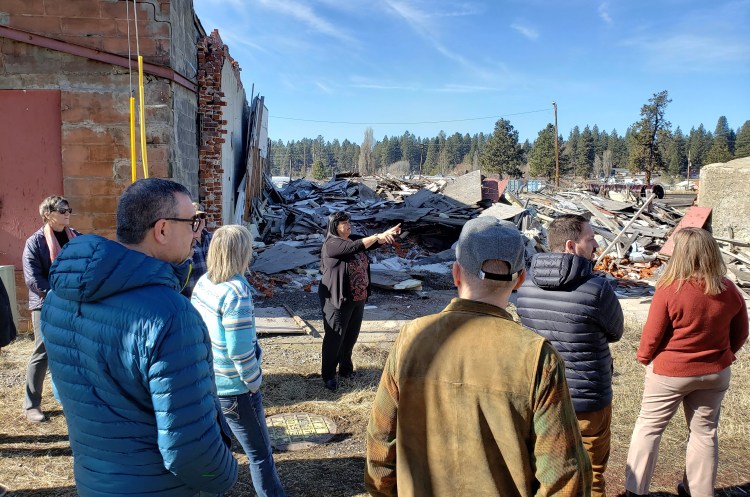
Chiloquin Mayor Julie Bettles discusses cleanup plans for a collapsed building in the city’s downtown.
“You picked a great day to visit,” said Chiloquin City Councilor Robert Cowie to the group of Eastern Region managers gathered at Chiloquin City Hall on a crisp, clear, sunny February afternoon.
The DEQ team traveled from The Dalles, Bend and Klamath Falls to meet leaders from the Klamath Tribes and City of Chiloquin to discuss local environmental concerns.
Bills become laws and state legislators design some Oregon laws to protect the environment. Most people understand that process.
But what about rules that put environmental protection into action? That’s where DEQ comes in through rulemaking. DEQ proposes rules that define how the public and industry interact with the environment in an effort to benefit the economy, human habitation and the preservation of natural areas.
Lauren and Dylan catch up with rulemaking experts at DEQ.
The Oregon Environmental Quality Commission selected Leah Feldon as the new director of the Department of Environmental Quality at a special meeting on Friday, Feb. 10, 2023. The commission’s vote was unanimous. The commission’s decision came after a seven-month nationwide search and included extensive input from the public and DEQ staff.
Photo provided by EWEB. This photo was taken in May 2021 on an EWEB Commissioners and local leaders tour of the damage of the Holiday Farm Fire. The Holiday Farm Fire destroyed more than 500 homes in the McKenzie River Valley, like this one pictured in May 2021. As the community continues to rebuild, EWEB and Oregon DEQ are eager to support people with funds to repair their septic systems damaged in the fire to alleviate their burdens and protect the water quality of the McKenzie River.
The 2020 Holiday Farm Fire east of Eugene burned 173,000 acres of the McKenzie Watershed, including 25 miles of river frontage. The fire destroyed more than 500 homes and many people are still rebuilding.
Oregon has some of the most beautiful and pristine skies in the United States. However, we can also experience poor air quality, and not just during wildfire season. In winter months, there are times when DEQ’s Air Quality Index indicates anything from “Moderate” to “Very Unhealthy” air, often due to stagnant air and inversions. Thankfully, these occurrences don’t tend to last very long.
We asked our friend, Travis Knudsen from Lane Regional Air Protection Agency, to write about this. As LRAPA’s public affairs manager and a former broadcast meteorologist, we feel he is exceedingly qualified to discuss these air quality events. His explanation follows:
This month, DEQ turns the spotlight on Orin Schmitt, who for many staff at DEQ, is one of their first points of contact at the agency. But Orin is more than about just onboarding new staff.
On Jan. 12, 2023, the Oregon Department of Environmental Quality launched a public survey to help its Air Quality Monitoring Team determine and prioritize 20 locations for new SensORs to measure air quality from wildfire smoke across the state. SensORs, which were first developed by DEQ’s Laboratory in 2019, are lower-cost monitors that collect timely particulate matter 2.5 data and display it over DEQ’s Air Quality Index.
Monsanto Company has agreed to pay Oregon $698 million to compensate for decades of contamination with chemicals known as polychlorinated biphenyls, or PCBs. The settlement comes after years of work by the state Department of Justice and other state agencies, including DEQ.
But did you know that at the holidays, we waste almost 1 pound per person at a single holiday meal (estimated Thanksgiving food waste at ReFED 2022 – The Food Waste Solutions Summit)? All that wasted food costs you money and has big environmental consequences in greenhouse gas generation, chemical pesticide and fertilizer use, and water and land use.
The holiday season may leave you with more food than you know what to do with, but don’t despair. Lauren and Dylan are here to help you prevent food waste while making all those leftovers disappear.
Need more incentive to make food waste prevention not just a holiday tradition, but also a year-round habit? On average, Oregonians lose about $1,600 per year due to food waste. So, reducing the amount of food that you waste could save you some serious money.
Deschutes River above Trout Creek by Dan Sobata (June 2022)
Mouth of Columbia River by Diana Adams (August 2022)
Yaquina Bay by Diana Adams (August 2022)
Wild Horse Lake on Steen Mountain by Dan Sobota (July 2022)
Sky Lakes Trees by Bill Meyers (Fall 2022)
Port Orford Intake – a drinking water source area – by Julie Harvey during watershed tour (September 2022)
Photo by Deb Mailander
Pacific Ocean from Neahkahnie Mountain with Nehalem Bay poking out on the left by Derek Sandoz
Oregon Coast Highway by Diana Adams (August 2022)
Nehalam River by Derek Sandoz
Metolius River near Wizard Falls by Mandy Ondrick
Margurette Lake by Bill Meyers (Fall 2022)
Manzanita Beach by Derek Sandoz
Flores Creek, drinking water source area, taken by Julie Harvey during a watershed tour
Elijah Bristow State Park by Mark Bentz (July 2022)
Beaver Creek at Ona Beach by Ranei Nomura taken during a response to a complaint
Celebrating 50 years of the Clean Water Act; envisioning the next 50
In honor of the 50th Anniversary of the Clean Water Act, we asked staff in DEQ’s water quality programs to share images they captured while working, playing or relaxing around water. These images highlight some of Oregon’s extraordinary water resources and the importance of protecting them.
“It is an illusion that photos are made with the camera… they are made with the eye, heart, and head.”
-Henri Cartier-Bresson
DEQ is proud of the work our water quality teams do to ensure these resources remain clean, safe and accessible for the next 50 years.
We’d love to know which photo is your favorite and why. Send a note to: DEQCommunications@deq.oregon.gov
Mercury is that strange element that looks like a liquid metal bead. Many adults played with it as children. Mercury was used in a bunch of household items – fluorescent bulbs, LCD screens, old appliances, batteries, thermometers and barometers – that are now at risk of spilling.
Lauren and Dylan talk with U.S. Environmental Protection Agency and Oregon Health Authority staff involved in a recent mercury spill in Bend that resulted in damage to the home, cars, furniture and $100,000 in cleanup costs for the homeowners. They help us understand how to respond if mercury does spill in your home to minimize the impact, and then DEQ staff tell us how to safely dispose of any items we own that we know contain mercury.
At the Oregon Department of Environmental Quality, we take our science seriously – nearly everything we do is backed by data and scientific analysis. Welcome to DEQ’s Lab, where the science happens.
Sanne Stienstra and Elaine Blatt with DEQ’s Materials Management Program enjoying a moment after Elaine’ s receive the AOR sustainability award.
Elaine Blatt and the Bad Apple Campaign Project Team received an Oregon Sustainability Award at the 2022 Association of Oregon Recyclers Conference this October. To be nominated for this prestigious recognition, individuals or teams must demonstrate a significant or outstanding accomplishment in recycling, waste prevention, reuse, or other sustainable materials management initiatives. Elaine and her team were celebrated for their actions that went above and beyond the normal scope of duties to bring attention to and spur action around the topic of food waste prevention. The environmental impacts of food waste are immense, yet the topic has remained under the radar compared with other issues related to sustainability, from microplastics to common household recycling. Elaine and her team, working with a marketing consulting firm, dreamed up and created a campaign that is at once engaging and informative without the “scolding” that sometimes can be associated with efforts to change environmentally damaging habits.
Left to right: Farhad Ghafarzade, Founder of Green Drop Garage; Jennie Romer, EPA Office of Chemical Safety and Pollution Prevention Deputy Assistant Administrator for Pollution Prevention; Lisa Cox, DEQ Toxic Reduction Analyst; Brittney Wendell, Associate Director, Pollution Prevention Resource Center
The U.S. Environmental Protection Agency has awarded $350,000 to the Oregon Department of Environmental Quality to support pollution prevention. EPA Office of Chemical Safety and Pollution Prevention Deputy Assistant Administrator for Pollution Prevention Jennie Romer announced what’s known as “P2” funding this week at an event in Portland, Oregon following a tour of Green Drop Garage, an EcoBiz certified automotive repair shop.
Rachel Sakata, DEQ ZEV program manager, gives a “thumbs up” after test driving a 26,000 lbs. medium-duty Daimler 3M2 emission-free semi-truck.
A contingent from Washington Department of Ecology joined DEQ’s Clean Fuels Program staff for two days of meetings aimed at learning how the program works and how industry uses cleaner transportation fuels. The visit included time with Oregon’s two largest electric utilities Portland General Electric and PacifiCorp, and a tour of Daimler Truck North America’s “Electric Island” in north Portland.
Ximena Cruz Cuevas (left), Brian Stafki (middle) and Laura Gleim (right) at ASCENT graduation ceremony Sept. 22, 2022
One thing that hasn’t changed at DEQ is the belief that our strength is our people. That strength is reflected in these three inspiring graduates of the 2022 ASCENT Transformational Leadership Program. Congratulations Ximena Cruz Cuevas, Northwest Region cleanup program coordinator (left), Brian Stafki, Materials Management natural resource specialist (middle) and Laura Gleim, Eastern Region public affairs specialist (right).
As National Source Water Protection Week comes to a close, the Drinking Water Protection staff at DEQ hopes more folks are aware of what we mean by the phrase source water protection. It is the core of our work, but it might not mean much to those outside our agency. As with many fields, the internal lingo often can be mysterious. In this case it’s not complicated. The place where one’s drinking water originates is its source area.
People often ask DEQ: how do you ensure facilities follow environmental laws? There are a lot of answers, but key parts are complaints, inspections and enforcement. This is the first of a two-part series that dives into the complaints and inspections process.
Lauren talks with the manager of the complaints system, a complaints inspector and two facility inspectors about how they receive complaints, find the source of pollution complaints, keep tabs on facilities that DEQ regulates and what happens when there is a violation.
Amanda Ingmire, a registered architect and policy analyst in DEQ’s Materials Management program, will receive the Women of Vision award from the Daily Journal of Commerce. DJC announced on Aug. 24, 2022 that they named Ingmire as an honoree of the 10th annual award.
Your DEQ Online crossed another significant milestone this week when the agency’s Climate Protection Program went fully functional in the system. This development means that businesses regulated under the program will have expanded ability to complete transactions in a secure online system.
Of the many things important to people in Oregon, a major one is water. DEQ plays a major role in protecting water quality of lakes, rivers and streams to ensure they can support aquatic plants and animals.
Lauren and Dylan talk to DEQ’s Water Quality Administrator about the state of Oregon’s water as well as the staff working on improving it.
Devil’s Lake was one of many lakes and reservoirs sampled during the 2017 Survey of Oregon Lakes.
Amid National Water Quality Month, the Oregon Department of Environmental Quality has released the 2017 Survey of Oregon Lakes. The report’s field work component was completed as a part of the U.S. Environmental Protection Agency’s overarching National Aquatic Resource Surveys Program, which includes the National Lakes Assessment every five years. The 2017 Survey of Oregon Lakes provides a statewide evaluation of the ecological condition of lakes and reservoirs. It also represents Oregon’s first-ever assessment of toxic compounds in those water bodies.
Diesel trash trucks are eligible for DEQ’s Diesel Emissions Mitigation Grants.
The Oregon Department of Environmental Quality recently announced recipients of nearly $7.5 million in funding for projects designed to reduce diesel emissions across the state and among vulnerable populations. Under the Diesel Emissions Mitigation Grant Program, eight selected projects will help eliminate air contaminants affecting public health and climate by retrofitting or replacing older medium- and heavy-duty diesel equipment with new, cleaner alternatives.
The Cleaner Air Oregon team is celebrating a significant milestone as companies that were among the first to be subject to the program are wrapping up the risk assessment and permitting processes.
Oregon Department of Environmental Quality staff and managers participated in two significant and successful public outreach events over the weekend of July 9-10: tabling at an Active Bethel Community event in Eugene and staffing a booth at The Big Float in Portland.
Bigstock photo of a row of glass bottles ready to be filled up in a beverage factory
After DEQ issued the Owens-Brockway glass recycling plant a $1 million fine in June 2021 for air quality violations, the company signed an agreement in October 2021 resolving the enforcement action and giving Owens-Brockway two options: install pollution controls or shut down.
Harris Beach State Park Beach Monitoring Program, Shane Bennett, 2021
Did you ever want to learn more about the part of DEQ collecting the data that produces the Air Quality Index or analyzing drinking water samples for Cyanobacteria Harmful Algal Blooms? Well, head on over to our new web page and meet the Laboratory and Environmental Assessment Division, a.k.a. the Lab!
Our photography contest features more than 50 images created by DEQ staff who work daily to protect Oregon’s air, land and water. The contest drew entries of stunning images from around the state —whether a shot from their travels or a selfie with a beloved creature or critter. Browse this gallery to see the judges’ top picks. We hope these inspire you.
First place: Whitehorse Falls. Photo and caption by Aaron K., vehicle inspector
Second place: Fancy meeting you here! On the edge of 7,000 feet, McNeil Point. Photo and caption by Grecia L., Human Resources Assistant
Third place: Fresh snow dusts Smith Rock on a quiet late-December evening. Photo and caption by Eileen N., agency toxics coordinator
Runner-up: Neowise over the Willamette. Photo by Steve S.,Senior Water Quality Permit Analyst
Climate change….fact or fiction? Photo of my backyard in Portland, Oregon (April 2022). Photo and caption by Kimberlee V., senior emergency response coordinator
What I love about Oregon; its wildness and beauty, with all its surprises and variability. Photo and caption by Michele T., web designer
Little Cultus Lake. Quiet gem of Central Oregon. Photo and caption by Randy J., Eastern Oregon Regional Solutions Program
One of my favorite things about Oregon is exploring the natural abundance of remote high-gradient streams, fly road in-hand, seeking wild, native fish with people I love. Photo and caption by Peter D., Sherwood Clean Air Station manager
An urban Earth Day. Scene from my bike commute near Hawthorne Bridge, Portland. Photo and caption by Harry E., communications manager
Playing disc golf at Rooster Rock, our Beagle’s “playground.” Photo by Corin Salnave, Heating Oil Tank Program, duty officer
Heron and hazy Rainier. Photo by Owen R., Air Quality Modeler in the Air Quality Technical Services section
Transgression. Regression. Photo and caption by Owen R., Air Quality Modeler in the Air Quality Technical Services section
McKenzie River headwaters at Clear Lake. Photo by Sarah M., Cleanup Project Manager
Sahalie Falls. Photo by Sarah M., Cleanup Project Manager
Rejoicing in the environment we are trying to protect and promote; view from Stacker Butte overlooking the Columbia River Gorge. Photo and caption by Spencer Bohaboy, Hazardous Waste Permit Writer
The Hoyt Arboretum in Portland is an investment in our planet as it provides a habitat to many animals, helps clean our water and air, and it’s a beautiful place for people to decompress and enjoy nature. Photo and caption by Sophia C., chemist, DEQ laboratory
Feathered friend at the Hoyt Arboretum, Portland. Photo by Sophia C., chemist, DEQ laboratory
Scenic drive on Hwy 224 along the banks of the Clackamas River, pre-fires. Much has changed there in two years. Photo and caption by Lee B., Northeast and Scappoose Clean Air Station Manager
Great view near the top of Banshee Hill in Winchester Bay. – our favorite place to go ride our quads and enjoy being outside! Photo and caption by Lee B., Northeast and Scappoose Clean Air Station Manager
Taking in the view at Painted Hills Observation area in northeastern Oregon during a a motorcycle and camping trip. Photo and caption by Lee B., Northeast and Scappoose Clean Air Station Manager
Silver Falls State Park with fog in the foothills. Photo and caption by Angela R., Water Quality Permitting Operations & Policy Analyst
Sunbeam at Cannon Beach/Photo and caption by Angela R., Water Quality Permitting Operations & Policy Analyst
Cape Lookout beach sunset. Photo and caption by Angela R., Water Quality Permitting Operations & Policy Analyst
Silver Falls in the early morning. Photo and caption by Angela R., Water Quality Permitting Operations & Policy Analyst
Rockaway Beach sunset reflection with Rosie. Photo and caption by Angela R., Water Quality Permitting Operations & Policy Analyst
Mt. McLoughlin reflection in Willow Lake. Photo by Aaron K., vehicle inspector, Vehicle Inspection Program-Medford
Lone Ranch Beach near Brookings. Photo by Aaron K., vehicle inspector, Vehicle Inspection Program-Medford
Mt. McLoughlin in the snow at sunset. Photo by Aaron K., vehicle inspector
Pearsony Falls in Prospect, Oregon. Photo by Aaron K., vehicle inspector
Camping in Lost Forest Natural Research Area where investing to conserve this remnant Ponderosa Pine forest, isolated by arid desert, pays back dividends in unique ecosystem benefits!/Photo and caption by Alex L., watershed program analyst
Springtime in Portland’s Waterfront Park/Photo and caption by Jennifer K., former program analyst, Clean Water State Revolving Fund
After a short but steep trek on a well-traveled path, you can follow a creek until it emerges into the basalt bowl that cradles Abiqua Falls. Photo and caption by Eileen N., agency toxics coordinator
As dusk fell over the Alvord Desert, we startled a covey of Greater Sage-Grouse and followed their flight path over the ice-crusted dry lakebed. Photo and caption by Eileen N., agency toxics coordinator
The meadows surrounding Todd Lake are bursting with wildflowers even into late summer and early fall. Photo and caption by Eileen N., agency toxics coordinator
In Siuslaw National Forest on a trail dominated by Bigleaf Maple, Douglas Fir and Western Hemlock at lower elevations, we climbed towards an old burn at higher elevation where ashy soil gave rise to late-summer goldenrod blooms. Photo and caption by Eileen N., agency toxics coordinator
Good morning, Mt. Hood/Photo by Jennifer F., public affairs specialist
Sea foam on kelp, Oregon coast/Photo by Greg C., water quality specialist, DEQ Lab
Top of Paulina Peak with a views of Paulina Lake, Mt. Bachelor, and Three Sisters. Photo and caption by Alex S., air quality permit writer and inspector
East side of Steens Mountain, view from Fields-Denino Road. Photo by Alex S., Air Quality Permit Writer and Inspector
Haystack Rock – A popular spot that Oregonians and visitors alike hold “deer” to their hearts. Photo and caption by Alex S., Air Quality Permit Writer and Inspector
Bandit on the Willamette. Photo and caption by Steve S., Senior Water Quality Permit Analyst
Sisters make best friends, Wahclella Falls. Photo and caption by Steve S., Senior Water Quality Permit Analyst
A girl’s best friend – Mary’s Peak. Photo and caption by Steve S., Senior Air Quality Permit Analyst
A girl’s best friend, Road’s End Beach. Photo and caption by Steve S., Senior Air Quality Permit Analyst
Mink Lake. Photo by Sara S., Eastern Region Watershed Manager
Lake Billy Chinook. Photo by Sara S., Eastern Region Watershed Manager
Riley Ranch. Photo by Sara S., Eastern Region Watershed Manager
Day dreaming above the clouds at McNeil Point. Photo and caption by Grecia L., Human Resources Assistant
Shocking and invitingly blue/ Slushie blue, but all true! Tamolitch Blue Pool, McKenzie River Trail. Photo and caption by Grecia L., Human Resources Assistant
Tucked away but not overshadowed, a beach full of natural splendors in Brookings, Oregon/Photo and caption by Grecia L., Human Resources Assistant
A bridge of sunlight to the heavens, Columbia River Gorge. Photo and caption by Grecia L., Human Resources Assistant
Mountain Inception, Crater Lake. Photo and caption by Grecia L., Human Resources Assistant
Take a stroll with me, Florence Dune. Photo and caption by Grecia L., Human Resources Assistant
Pre-historic and grand creations, McNeil Point, Mt. Hood. Photo and caption by Grecia L., Human Resources Assistant
Tom McCall Waterfront in Portland. Photo by Lauren R., Operations and Policy Analyst
DEQ Natural Resource Specialist Lesley Merrick looks for aquatic critters, a sign of a health stream.
Warm water continues to be the top source of pollution in Oregon’s rivers and streams, according to the latest and most detailed report produced by the Oregon Department of Environmental Quality. The 2022 Integrated Report on state water quality, as it is called, is now in the hands of the U.S. Environmental Protection Agency, which must approve its findings before it becomes official.
After eight months of conversations with the community, the Oregon Department of Environmental Quality has made progress towards addressing soil contamination and protecting community health in Cathedral Park. DEQ, the Oregon Health Authority and City of Portland staff were out in the park for three days in mid-May talking to community members about soil sampling and cleanup work in the park as part of the N. Bradford Street Cleanup Project.
PROJECT ACCOMPLISHMENTS • 5 community meetings • 73 survey responses • 4 signs installed • 24 hours of community outreach • 12 sampling areas
We Oregonians are proud of the beautiful and diverse landscape of our state from the Pacific coast to mountains, rivers, waterfalls, desert, forests and farmland. Oregon also enjoys a “green halo” for our forward-looking outlook about the materials we make and consume to maintain our quality of life. But did you know that you live in the only state that has a 2050 Vision, which was adopted by the Environmental Quality Commission, for how we make and use those materials and how we account for the impacts they generate? Ten years on and Oregon is still the only state with a mechanism for envisioning pathways towards 2050 that protect the beauty and grandeur of Oregon for generations to come.
Bridge sampling location on the South Fork Coos River for the Ambient Water Quality Monitoring Program.
The Oregon Department of Environmental Quality has released the 2021 Oregon Water Quality Index. It assesses water quality at 160 ambient monitoring stations across the state. The goal is to determine the status and identify trends in waters of the state for ambient water quality conditions. The OWQI is the only water quality key performance measure reported to the Oregon Legislature. However, unlike the Integrated Report or the Water Quality Status and Trends Report, the OWQI is not compared to water quality standards; does not evaluate if beneficial uses are supported; does not have regulatory standing; nor does it attempt to identify pollutant sources contributing to water quality impairments.
Earth Day 2022 has come and gone, but I still think about the iconic “Earth Rise” image. Because I am a geographer, I recognize the collective and sweeping focus and perspective on air, land and water all Oregon Department of Environmental Quality’s employees share in our common mission. For me and my own niche, it is such a privilege to work alongside dedicated DEQ professionals, and through the variety of ways the Regional Solutions program compliments and extends our work.
I hope that this larger view of Oregon has a positive trajectory that further motivates us, just like the perspectives Earth Rise has created.
Investments in the health and resilience of Chicken Creek will benefit wildlife and the local community.
An innovative program is helping restore streambank vegetation across Oregon. The program, one of the Oregon Department of Environmental Quality’s many, is called “water quality trading,” and trading is one of several forward-thinking efforts DEQ uses to boost investment in green infrastructure. Green infrastructure is the practice of using natural ecosystems to deliver specific services. Planting trees and other vegetation along streams to shade waterways is just one example of green infrastructure. The positive benefits of planting trees along streams (also known as riparian restoration) are well established, and include streambank stabilization, sediment and pollution filtration, wildlife habitat, water retention, and carbon sequestration. Many Oregon streams have few riparian trees to perform these important functions.
DEQ’s own Aaron Borisenko has been nominated for a 2022 Public Service Recognition Week Award for his work as part of the interagency Wildfire Science Team. The team is up for the Interagency Excellence Team Award category, which honors cross-agency collaboration, stakeholder engagement and innovative approaches to intractable problems.
Starting in July, a 4% technology fee will be charged on all financial transactions in Your DEQ Online, except agency-issued penalties. The fee, which was authorized by the 2021 Oregon Legislature, is necessary to pay for annual operation and maintenance costs of Your DEQ Online.
Some of the Air Quality Monitoring Team with a SensOR outside the Lab in Hillsboro (L to R): Luke Mattheis, Tom Roick, Dan Johnson and Anthony Barnack.
It’s Air Quality Awareness Week and the DEQ Laboratory and Environmental Assessment Division (You may know us as “The Lab”) thought it a great time to address one of the most common questions we receive: What is the difference between air quality data collected by DEQ and that collected by people with low-cost sensors? As scientists, we might frame the question as so: How do I collect data of known quality?
Minal is the Business Initiatives Lead with DEQ’s Materials Management Program. He focuses on enhancing well-being in the life cycles of materials produced and consumed in Oregon.
My parents were depression-era Oklahoma farm kids who came of age at a time and place that required men and women to have practical knowledge about a bit of everything. They were carpenters, hunters, farmers, seamstresses, veterinarians and mechanics. They grew or raised their own food and preserved it for lean times.
Recent headlines warn that the window is quickly closing to protect our future and preserve a livable planet. In Oregon, we have seen the effects of the climate crisis first-hand: hundreds of deaths from extreme heat waves; thousands of homes destroyed by wildfire; lakes and rivers drying up before our eyes; farmers without water to grow food; and the toxic algal blooms that shut down the city of Salem’s drinking water system for weeks in 2018.
Governor Kate Brown has proclaimed April 4 – 8, 2022 to be Food Waste Prevention Week, and the Oregon Department of Environmental Quality is encouraging everyone living across the state to take simple steps to reduce waste and save money. Reducing food waste matters for a variety of reasons, including:
Up to 35% of all food in the U.S. is wasted and costs every Oregon household $1,800 per year on average (The EPA recently updated this figure from $1,600)
Food accounts for the second highest contribution to greenhouse gases by Oregon residents
Preventing one ton of food from being wasted reduces significantly more greenhouse gases than simply keeping food waste out of landfills
Seventy percent of food Oregon households throw out could have been eaten had it not been allowed to spoil. This food differs from the peels, bones and shells that clearly couldn’t be eaten
“This week is about highlighting the importance of reducing food waste to ensure fuller wallets and reduced harm to our environment,” says Elaine Blatt, senior policy analyst at DEQ. “By focusing on preventing food waste, we hope Oregon households will learn approaches they can use now and in the future to save money and protect our planet.”
There are many steps you can take to reduce food waste. Consider trying some of the following:
Store food that will go bad soonest in a visible part of the fridge or pantry
Know how and where to store food properly so it lasts longer (visit dontletgoodfoodgobad.org for specific tips on different types of food)
Keep track of what you have at home or what you need to use up before it goes bad
Create meals from what you have on hand
Finish all your leftovers
Freeze for later use
Monitor the temperature in the fridge to make sure it’s at the best setting to preserve your food
Check your refrigerator and pantry before you shop
During Food Waste Prevention Week, our partners at Save the Food Florida are running a fun twist on a traditional game. It’s called Bad Apple Bingo! Just save the photo below (or take a screenshot) and mark your bingo card with the action you take each day. Then repost using #savethefoodfl and tagging @SavetheFoodFL to be eligible to win! Aren’t into social media? No problem. Print the card and use it as a guide for how to fight food waste at home.
Bad Apple Bingo!
There’s more good news too! In the run-up to Food Waste Prevention Week, students around the country recently participated in the FOOD FUTURE HACK-A-THON. This contest challenged students to compete with their peers to solve a food waste challenge in a virtual invention marathon culminating with the presentation of a short, 2-3 minute video illustrating each team’s solutions.
The Eco Reps Team from Oregon State University won an award in the “Best Idea” category. Their project, “Crop Circle”, outlines an innovative program connecting farms and schools to bring fresh fruits and vegetables to schools.
Finally, there are other ways to participate in Food Waste Prevention Week. These include more games and challenges, K-12 student engagement contests, invention marathons and presentations with special guests, including celebrated local chefs and elected officials. Visit www.foodwastepreventionweek.com for all the details.
By Julie Miller, communications specialist, Materials Management, Oregon DEQ
UNESCO commemorates International Day of Women and Girls in Science every Feb. 11 as part of an effort to educate the world about the barriers women and girls face when considering STEM careers. In honor of that day and as part of March’s celebration of women’s history, we asked DEQ employees their perspectives on why there aren’t more women in the science fields and what we can do about it. We received a wide variety of replies, which you can read below.
The U.S. Senate Committee on Environment and Public Works recently held a hearing on biofuels policy during which Cory-Ann Wind had the opportunity to talk about Oregon’s Clean Fuels Program – one of the most successful statewide policies for addressing the state’s contribution to global climate change. Managed by the Oregon Department of Environmental Quality, the program began in 2016 with the goal of cutting carbon emissions from transportation sector, the single biggest source of greenhouse gas emissions in the state.
The Oregon Department of Environmental Quality is removing petroleum-contaminated soil at Johnson Oil, a former gas station and car dealership in Clatskanie that began operating in 1957. The soil-removal is the latest effort to clean up the site, which has a history of contamination dating back to the 1980s. Columbia County acquired the property through foreclosure in 2007.
DEQ collaborated with the Clatskanie Cultural Center on a Story Map to provide a summary of site activities, current risk and future plans for Johnson Oil.
This is a voluntary, non-regulatory program that supports environmental workforce development, waste reduction, environmental protection and economic savings. This year, the program is especially interested in working with coastal businesses, B-Corps, the metal finishing industry, small businesses and the food and beverage sector.
Rebates for low- and moderate-income households increased as of Jan. 1, 2022.
The Oregon Department of Environmental Quality has made big changes to the Oregon Clean Vehicle Rebate Program’s Charge Ahead Rebate. As of Jan. 1, 2022, low- and moderate-income households are eligible for $5,000 back with the purchase or lease of a new or used battery electric or plug-in hybrid electric vehicle. Previously, the Charge Ahead Rebate was $2,500. In addition, if the purchase or lease is a new battery electric or plug-in hybrid electric vehicle, then the rebate can be combined with the Standard Rebate for up to $7,500 back.
The Oregon Legislature agreed to the increase in May 2021. It also expanded the Charge Ahead Rebate to make low-income service providers eligible for money back.
New DEQ program will reduce greenhouse gas emissions in Oregon by 90% by 2050
Statewide, OR — Today the Oregon Environmental Quality Commission voted 3-1 to establish the Climate Protection Program which sets enforceable and declining limits on greenhouse gas emissions from fossil fuels used throughout Oregon. The limits apply to diesel, gasoline, natural gas and propane, used in transportation, residential, commercial and industrial settings.
Along with other actions by the Oregon Legislature, this makes Oregon one of the few states in the nation with a comprehensive and clear pathway to reducing the emissions that cause global warming. As approved, the new rules put Oregon on track to reduce emissions from fossil fuels by 50% by 2035 and 90% by 2050, reductions that scientists agree are required to avoid the worst effects of climate change.
As part of ongoing efforts to improve air quality, the Oregon Department of Environmental Quality today announced recipients of $8.1 million in funding for projects designed to reduce diesel emissions across the state and among vulnerable populations. Under the Diesel Emissions Mitigation Grant Program, 12 projects will help eliminate air contaminants affecting public health and climate by retrofitting or replacing older medium- and heavy-duty diesel equipment with new, cleaner alternatives.
“Diesel pollution is a hazard to public health, especially for our most vulnerable community members, and today’s action will permanently remove tons of toxic emissions from our air,” said Oregon State Representative Rob Nosse. “DEQ’s grant program provides valuable support for diesel equipment owners to replace their older, more polluting equipment. I am excited to see this support go out to these businesses.”
The selected projects will remove more than 200 tons of harmful air pollution, including nitrogen oxide and fine particulate matter, from Oregon’s air. They range from installing diesel particulate filters in heavy-duty truck fleets based in the Portland Metro area to replacing diesel-powered street sweepers with new, zero emissions electric equipment in the Willamette Valley, to converting waste and freight hauling trucks to zero emissions electric transportation across the state.
“These grants represent our commitment to reducing diesel emissions and supporting the transition of Oregon’s medium- and heavy-duty truck fleets to zero emissions in the future.
DEQ Air Quality Division Administrator Ali Mirzakhalili.
Recipients and awards include:
Recipient: Aramark Uniform & Career Apparel Group, Inc. Primary Location: Portland Project Upgrade Type: Four (4) Electric Equipment Replacements Grant Amount: $600,000
Recipient: Bedrock Concrete Cutting Primary Location: Portland Project Upgrade Type: Three (3) Electric Equipment Replacements Grant Amount: $201,475.51
Recipient: Cadman/Lehigh Hanson Primary Location: Portland Project Upgrade Type: Sixty-Three (63) Exhaust Control Retrofits Grant Amount: $1,216,972.89
Recipient: City of Newberg Primary Location: Newberg Project Upgrade Type: One (1) Electric Equipment Replacement Grant Amount: $293,066
Recipient: City of Portland Primary Location: Portland Project Upgrade Type: Eight (8) Electric Equipment Replacements Grant Amount: $2,660,234
Recipient: City of Roses Disposal & Recycling Primary Location: Portland Project Upgrade Type: One (1) Electric Equipment Replacement Grant Amount: $238,046.50
Recipient: DeVry Construction LLC Primary Location: Medford Project Upgrade Type: One (1) Diesel Equipment Replacement Grant Amount: $25,994.80
Recipient: DMH Inc. Primary Location: Forest Grove Project Upgrade Type: One (1) Exhaust Control Retrofit Grant Amount: $14,006.63
Recipient: Estes Express Lines Primary Location: Portland Project Upgrade Type: Thirteen (13) Diesel Equipment Replacements Grant Amount: $316,783.75
Recipient: Morgan Industrial, Inc. Primary Location: Hillsboro Project Upgrade Type: Sixteen (16) Diesel Equipment Replacements Grant Amount: $704,606.09
Recipient: TITAN Freight Systems Primary Location: Portland Project Upgrade Type: Six (6) Electric Equipment Replacements Grant Amount: $1,288,579.50
2021 Total Grant Amount: $8,111,015.67
“These grants represent our commitment to reducing diesel emissions and supporting the transition of Oregon’s medium- and heavy-duty truck fleets to zero emissions in the future,” said DEQ Air Quality Division Administrator Ali Mirzakhalili. “Combined with the Oregon Environmental Quality Commission’s recent decision to adopt the Advanced Clean Truck rules, we are leading the way to cleaner air in Oregon.”
DEQ’s Air Quality Program staff reviewed 71 grant applications, totaling more than $53 million in funding, and applied specific criteria from the Oregon Legislature and related administrative rules to evaluate proposed projects according to a point system. The 55 total points broke down as follows:
• Project summary and approach (5 points) • Project eligibility and type (15 points) • Project cost and air quality benefits (5 points) • Project location (10 points) • Applicant and fleet profile (20 points)
Project location criterion included a GIS evaluation against a vulnerable population map . The review considered how a proposed project would improve air quality in areas with the highest diesel emissions, most vulnerable populations and highest population densities.
Starting this month, DEQ will work with grant recipients to finalize project details and agreements. Funding will not be released until the process is complete. Project work should begin by mid-February 2022.
DEQ has approximately $40 million from the Environmental Mitigation Trust Fund established after Volkswagen was found to have cheated on emissions standards. The agency will award approximately $8 million in grants per year for five consecutive calendar years, beginning in 2021 and ending in 2025.
As we commemorate Veterans Day, we appreciate how the many veterans and active-duty military working at the Oregon Department of Environmental Quality are continuing the call to service in their current jobs. DEQ is proud to have 48 military service members on staff. We honor them for their sacrifices and thank them for always saying “yes” when called upon to support our country and Oregonians.
Photo (left to right): Gregor Robertson, Jennifer Hennessey (Gov. Inslee’s Senior Policy Advisor for Environment, Water & Ocean Health), Shereen D’Souza (California Deputy Secretary for Climate Policy and Government Relations), Kate Brown (Governor of State of Oregon), Marcene Mitchell (Senior Vice President of Climate Change, World Wildlife Fund), Dr. Richard Swannell (International Director of WRAP) and Jane Ewing (Senior Vice President of Sustainability at Walmart).
Earlier this week, Oregon Governor Kate Brown shared the Oregon Department of Environmental Quality’s work on a global stage when she served as a panelist on a session titled “Partnerships to Reduce Wasted Food on the American West Coast” at COP26, the 2021 United Nations climate change conference.
Speaking from Glasgow, Scotland, Governor Brown talked about Oregon’s climate emergency and how the state is taking meaningful steps to combat climate change through food waste reduction. The session, hosted by the Pacific Coast Collaborative, included members of the Pacific Coast Food Waste Commitment. The PCFWC is an unprecedented public-private partnership featuring some of the nation’s largest food businesses alongside local, state, and provincial governments – all working collaboratively toward a shared ambition of effective, industry-wide actions that prevent and reduce wasted food along the West Coast.
“Having the PCC [Pacific Coast Collaborative] allows us to share, replicate and learn from one another in ways that are extraordinarily valuable,” Governor Brown said.
Food that is grown and never eaten consumes an enormous amount of natural resources, and is responsible for 4 percent of U.S. greenhouse gas emissions. According to Oregon’s own Consumption-Based Emissions Inventory, food is the second largest source of greenhouse gas emissions caused by people in Oregon after transportation. To address this, Governor Brown included a directive in her 2020 Executive Order 20-04 on Climate that instructs DEQ to “take actions necessary to prevent and recover food waste, with the goal of reducing food waste by 50 percent by 2030.”
“We have to move further and faster,” Governor Brown said. “We just have to, no other choice.”
Among the efforts Governor Brown highlighted was Oregon’s new Bad Apple campaign, designed to help Oregon households save money and reduce food waste at home. The governor said she appreciated the campaign’s use of humor and direct appeal to consumers to save money.
Photo: The Columbia Slough is a 19-mile-long complex of narrow, shallow channels located on the southern floodplain of the Columbia River between Fairview Lake and the Willamette River.
You might not know this, but keeping poop out of the water is a lot of work! The Department of Environmental Quality is responsible for keeping Oregon’s waters safe and healthy and restoring streams and lakes from sources of nonpoint source pollution, such as bacteria from human and animal waste. This is a long-term investment that takes a combination of resources, partnerships and time.
An onsite septic system at a country home in Oregon.
An affordable loan program is again available for homeowners and small businesses in Oregon to repair or replace failing septic systems. Fixing or replacing failing septic systems benefits Oregonians by protecting public health and addressing threats to water quality.
The Oregon Department of Environmental Quality and regional nonprofit lender Craft3 are teaming up to make Craft3’s Clean Water Loans available throughout the state. The Oregon Legislature approved $2 million for the program in the last session and Craft3 began accepting loan applications on Nov. 1, 2021.
The Oregon Department of Environmental Quality has awarded Oregon Green Schools $10,000 to help the nonprofit transition from a fully volunteer organization to establishing a more formal structure, including a small, paid professional staff. This shift will strengthen and expand OGS’s activities with schools across the state.
Photos: Students complete the Oregon Green Schools Green lunchroom audit to better understand food waste.
Lynda Viray, taking a selfie, social distancing and enjoying coffee on vacation.
Filipino Americans make up one of the largest ethnic groups in the United States with nearly 20,000 residing in the State of Oregon. Every October we celebrate Filipino heritage to increase awareness of the significant role Filipinos have played in American history.
We had the opportunity to talk to Lynda Viray, someone who knows first hand about Filipino American heritage, to learn about her role at the Oregon Department of Quality, her background and what makes her tick. Lynda’s story is a reminder of the social, cultural, intellectual and economic contributions of Filipino Americans in the nation and Oregon.
Spoiled food is costing Oregon households real money. In fact, every year the average household loses $1,600 by throwing away spoiled food. And while many people are already taking steps to reduce food waste, research funded by the Oregon Department of Environmental Quality found that 85% of Oregon households agreed they could do more to reduce food spoilage.
Lisa Cox (Oregon Department of Environmental Quality) and Brittney Wendell (Pollution Prevention Resource Center)
The Oregon Department of Environmental Quality is a recipient of the U.S. Environmental Protection Agency’s 2021 Safer Choice Partner of the Year Award. EPA’s announcement of the 33 award winners on Sept. 22 coincides with Pollution Prevention Week. The award recognizes outstanding achievement in the design, manufacture, promotion and use of environmentally friendly products in homes, schools and businesses. Awardees were selected for active and exemplary participation in and promotion of the product certification and labeling program.
The harsh part of growing up as a minority is growing up not knowing that your background makes you an “other.” You could spend your whole life not knowing that you’re being treated differently, that you’re even different to begin with. You’re just you. It can take a long time to understand the full ramifications of that.
“I’ll count to three this time and we’ll clap after three, ok? One. Two. Three…”
Dylan Darling and Lauren Wirtis simultaneously clap into their microphones – a trick that makes it easier to align their separate recordings. You know in movies when the person says “take six!” and then snap the clapper board shut? Same thing.
You might think customers grumble when they drive their car into one of DEQ’s vehicle inspection stations – it’s time out of their day, after all, and it costs money. But think again. Over the past three months, surveys show a stunning 98.8 percent customer satisfaction with the Vehicle Inspection Program.
DEQ helped launch the program, where high school students earn college credit studying the John Day River watershed
For eight years, high school students in rural communities have earned college credits and learned about watershed science in the outdoor classroom provided by the Cottonwood Crossing Summer Institute. The program includes hands-on learning at Cottonwood Canyon State Park, Oregon’s largest at 8,000 acres. 2021 was another success!
With all the surface water from the John Day River basin flowing through the park, Cottonwood Canyon is an ideal place for STEM-centered outdoor learning, including a fuller appreciation for the river’s connection to upstream communities. Students are able to study the John Day River watershed from its uppermost reaches to the Columbia River confluence – its seasons, histories, economies, communities and biomes.
Photo credit: CCSI, 2019
The program also provides career pathways in fields such as recreation management, hydrology, geology, botany, wildlife sciences, photojournalism, technical/descriptive writing, history, renewable energy technologies and communications and public speaking.
The Oregon Department of Environmental Quality helped launch the institute in partnership with the Eastern Oregon Regional Solutions Program, Gilliam and Wheeler counties, Oregon Parks and Recreation Department, Eastern Oregon University, BLM Prineville District, John Day and Snake River Resource Advisory Council, U.S. Forest Service, NRCS, Oregon Water Enhancement Board, Oregon Department of Fish and Wildlife and Oregon Water Resource Department.
The air quality at Mirror Pond in Bend measured in the Hazardous range on Sept. 14, 2020.
The number of unhealthy air quality days caused by wildfires are increasing across Oregon. In 2020, those living here experienced the worst air quality ever recorded in the state.
Meandering through the sagebrush and juniper trails at the Stevens Road Tract in southeast Bend, a hiker might never suspect they are walking over acres of buried trash.
Decades-old tires, building materials containing asbestos and household trash fill in former holes and collapsed lava tubes on about 40 acres of the newly planned 382-acre mixed-use housing and commercial development called Stevens Ranch. And soon, much of that trash will be cleaned up and either recycled or deposited in a modern landfill that’s built to protect people and wildlife from trash and the pollution it can create.
Jackson Dougan arrived at DEQ a little over two years ago, after completing a Master of Science in Global Change: Ecosystem Science & Policy from the University College Dublin in Ireland, as well as working in the New York State’s Office of the Attorney General and at the Environmental Defense Fund, among other places. He currently works as a natural resource specialist in the Greenhouse Gas Reporting Program.
As a proud member of the LGBTQIA2S+ community, we thought this month would be a good time to check in with Jackson to see what he has been up to and if he has any recommendations for those who would like to learn more about his community.
Governor Kate Brown this week signed legislation to expand access to electric vehicles and charging infrastructure, particularly to people with low incomes and people of color.
By removing the current sunset on funding, House Bill 2165 will allow the Oregon Department of Environmental Quality to continue offering rebates to those who buy electric vehicles.
Ramesh Manickam, Your DEQ Online Risk Manager, is working with the new data management system.
Nearly three weeks into the official launch of Your DEQ Online, the agency’s new data management system, responses have been overwhelmingly positive.
“It has been very smooth,” said Ramesh Manickam, who serves as risk manager for the massive technology project. “We have not had any problems so far.”
Your DEQ Online allows regulated industries to conduct business with DEQ entirely online, including permits, certifications and licenses. It also offers electronic payments for fees and fines. The new system is being phased in over two years.
For years, the Oregon Smoke Blog has been the go-to resource for anyone wanting to learn the latest and best information on smoke conditions during wildfire season. And now, the blog is even better.
In preparation for the upcoming summer months, DEQ has revamped the blog to give it a cleaner design and make it more user friendly. It also is much more adaptable to mobile phone use, which is increasingly the preferred method for accessing the blog.
No matter how hard we work at “spring cleaning,” there’s often one area that’s overlooked – our old, unused electronics. A recent survey found that most of us in Oregon have broken or obsolete TVs, computers, printers or other electronics hiding in plain sight at home. These electronics languish in closets or under sofas, in attics or storage and generally evade our spring cleaning efforts.
The Oregon Department of Quality’s own Martina Frey has been chosen to serve on a national board that is working to modernize the U.S. Environmental Protection Agency’s database for permit compliance and enforcement data.
Martina was one of a handful of water quality experts selected from across the United States to be part of the ICIS Modernization Board. ICIS stands for Integrated Compliance Information System, and is where states and EPA regional branches report their monitoring and enforcement activities.
Ali Mirzakhalili has worked as Oregon DEQ’s Air Quality Division administrator since 2018, but he has been involved with environmental issues for much longer. For Air Quality Awareness Week, we thought it was a good time to ask him about what drew him to this work and how he feels about Oregon’s environmental future.
DEQ’s Nick Haxton-Evans takes a water sample from a groundwater well in Harney County.
A new report from the Oregon Department of Environmental Quality’s Laboratory shows water quality data for groundwater in Harney County.
DEQ sampled water from 91 residential, agricultural and monitoring wells in the county and detected 42 different chemicals, including bacteria, pesticides, metals and nutrients. Some of these chemicals naturally exist within water and others are potential contaminants.
The COVID-19 pandemic reinforced the importance of science to inform both government response and individual action. Climate science is used in a similar way to shape decision-making that can deliver a safe, equitable and sustainable future.
At the Oregon Department of Environmental Quality, science is the cornerstone of the work we do to better understand the health of Oregon’s environment.
With just 82 employees, the Oregon Laboratory and Environmental Assessment Division, DEQ’s lab, provides the scientific and technical capacity to respond quickly to a broad range of emerging issues and unprecedented events, such as wildfires, that affect public health and the environment.
Curbing the 35% of food that goes uneaten each year will help reduce greenhouse gas emissions, conserve water and land resources, and support those facing food insecurity— which has become increasingly critical in the wake of COVID-19. DEQ’s Materials Management program prioritizes food waste reduction, and leads a variety of projects to reduce food waste. One of those efforts is DEQ’s ongoing support of regional food waste reductions through the Pacific Coast Collaborative, an international governmental agency focused on several environmental initiatives, including food waste reduction.
The Oregon Environmental Quality Commission made headlines recently with a landmark decision to grant additional environmental protections to Crater and Waldo lakes, known for their clear, pristine water. The commission’s approval of the Outstanding Resource Water designation was the end result of months of work by DEQ’s Water Quality Program, from thorough research to public outreach.
Sarah Idczak, DEQ Emergency Response GIS Coordinator
Mention Earth Day, and DEQ’s Sarah Idczak thinks back to her days as an undergrad at Western Washington University.
“The environmental college hosted an Annual Earth Day Festival. There were live bands, great food and lots of dancing. It was a great chance to take a step back from all the environmental problems we were studying and celebrate the victories,” says Idczak. “It allowed us to take a breath and just celebrate this big, beautiful blue marble that we all get to call home.”
Cleanup of a gasoline leak at Highway 99 and Main Street in Monmouth in April 2021. [Department of Environmental Quality]
This is the most current information about DEQ’s response efforts in Monmouth, where gasoline leaked into the sewer system and caused gasoline vapors to enter several buildings on Main Street.
Bridge sampling location for the ambient water quality monitoring program.
The Oregon Department of Environmental Quality has released the 2020 Oregon Water Quality Index. The index assesses water quality at 160 ambient monitoring stations across the state. The goal is to determine the status and identify trends in waters of the state for ambient water quality conditions. The OWQI is the only water quality key performance measure reported to the Oregon Legislature. However, unlike the Integrated Report and Total Maximum Daily Load reports, the OWQI is not compared to water quality standards; does not evaluate if beneficial uses are supported; does not have regulatory standing; nor does it attempt to identify pollutant sources contributing to water quality impairments.
On March 31, 2021, the Oregon Department of Environmental Quality issued the final cleanup plan for the Willamette Cove Upland. Willamette Cove is a 3,000-foot long property along the east bank of the Willamette River just north of the Steel Bridge. Historically used as a cooperage (barrel-making), lumber mill and dry dock, the site has extensive residual contamination.
Willamette Cove during its industrial phase in 1923 (left), and how it looks today (right)
DEQ has determined partial removal of contaminated soil, with a containment area for the remainder, will protect human health and the environment. Additionally, DEQ added a contingency remedy that will provide Metro flexibility as they finalize their planning for the site. The contingency remedy allows Metro to choose to move more contaminated material off-site and shrink the consolidation area. Read the final cleanup plan.
What does this really mean for the future of the upland area? Here are three things you need to know:
As Women’s History Month comes to a close, Oregon DEQ wants to honor and celebrate the many women in our agency, who work tirelessly to restore, maintain and enhance our state’s air, land and water. Their hard work, expertise and lived experiences provide unique perspectives and contributions to our mission.
Over the last month, we approached women who were new to DEQ, as well as those who have worked here a while and moved into new positions in the agency, and asked them the following question:
How do you think your experience as a woman has informed your work at DEQ?
Those early positive and supportive interactions with women managers gave me confidence and validation.
Jennifer Wigal, DEQ Water Quality Deputy Director
I’ve pursued paths that, while they weren’t unheard of for women, women were definitely in the minority. I pursued my undergraduate degree in civil engineering at a time when women made up about 10% of the students in my degree program. That was the highest percentage among all the engineering fields of study at the time.
Massive hills of pinkish red rock stand along a lonely dirt road in far southeastern Oregon, near the Nevada border. They’re beautiful, reminiscent of Oregon’s treasured Painted Hills.
But there’s one big difference: these rocks are toxic.
Beaverton School District rolls out the first electric school busses in Oregon. [Beaverton School District video]
The Beaverton School District and Portland General Electric have partnered to bring the first two electric school buses to Oregon. Each vehicle will cut about 52,000 pounds of carbon dioxide from the atmosphere each year. That means students, drivers and neighborhoods will breathe cleaner air and overall air quality will improve.
Across the state, students are beginning to head back to in-person schooling, and that means more and more school buses are returning to the roads. As such, Oregon DEQ is working to make that transportation cleaner and safer for those children and the environment.
Inspector checking vehicle diagnostics while customer waits at a safe distance in compliance with COVID-19 guidelines.
From the extraordinary pandemic to the intruding smoke from massive wildfires, 2020 presented Oregon DEQ’s vehicle testing inspectors with demands they had never before encountered. Through ingenuity, flexibility and teamwork, they were able to move from standard operating procedures to an entirely new set of safety protocols and disinfection guidelines, all while maintaining the high quality of service and efficiency for which they are known.
A new report, “Oregon DEQ Vehicle Inspection Program 2020 Update,” summarizes how the program managed the challenges. It provides details on staffing, testing options, improvement initiatives and what to expect next from the team.
Dan Sutherland disinfecting his station between customer visits at the NE Portland vehicle inspection station, June 30, 2020.
Vehicle Inspection Program employees are Oregon DEQ’s frontline workers. They work with the public six days a week to ensure that fewer and fewer emissions and hazardous pollutants enter the environment. We are grateful for their service.
Waldo Lake with Diamond Peak in the background on Sept. 5, 2020. Joe Yuska paddles a kayak across the exceptionally clear waters. [Photo by Debra Sturdevant, Copyright 2020]
Crater Lake and Waldo Lake have always stood out as waters in Oregon.
Crater Lake, the namesake for the only National Park in the state, has clear blue water. The deep lake fills a volcanic caldera. Waldo Lake, nestled into the Cascades near Oakridge, holds exceptionally clear water. So clear that it is like distilled water.
The value of the pristine waters held by Crater and Waldo lakes is undeniable. But now it is official and the lakes have added state protections after action taken Thursday by the Environmental Quality Commission. The rulemaking board, which oversees the Oregon Department of Environmental Quality, voted 4-0 to designate Crater Lake and Waldo Lake as Outstanding Resource Waters.
“Crater Lake and Waldo Lake are unique and invaluable treasures for Oregonians and the world,” said DEQ Director Richard Whitman. “Their crystal clear clean waters represent the best of Oregon’s natural beauty. By designating the lakes as Outstanding Resource Waters, Oregon’s Environmental Quality Commission is assuring that these special places will remain unspoiled for present and future generations.”
It is only the second time the commission granted the special status to waters in Oregon. Crater Lake and Waldo Lake join the North Fork Smith River in Southwest Oregon as Outstanding Resource Waters. The commission classified the remote river, which begins in the Kalmiopsis Wilderness, and its tributaries in 2017.
The Outstanding Resource Waters designation for Crater Lake and Waldo Lake prevents activities that would potentially harm water quality at either lake. It prohibits permitted discharges into the waters, except for short-term stormwater permits for construction. The designation also prohibits any new discharges, with the exception of those resulting from public health or safety emergencies or restoration and improvement projects. Existing recreation and tourism activities will continue at both lakes.
“It’s an honor to grant additional protection to two of Oregon’s natural wonders, Crater Lake and Waldo Lake,” said EQC Chair Kathleen George. “This special recognition will preserve the natural habitat, cultural and recreational benefits of these amazing places for future generations.”
The vote on Thursday came in response to a citizen petition submitted to the commission by the Northwest Environmental Defense Center in 2019. The nonprofit called for protections for Waldo Lake and the commission added Crater Lake to the proposal. The ruling amends Oregon’s water quality standards to ensure that the current high water quality and exceptional ecological characteristics and recreational values of these waters are protected.
Crater Lake from Watchman Observation Station along the caldera rim on Thanksgiving weekend circa 2015. [Photo by Debra Sturdevant, Copyright 2015]
Both lakes offer exceptional clarity and vibrant blue waters. While most lakes in the United States have visibility of less than 30 feet, Crater Lake and Waldo Lake have average visibilities of more than 100 feet. Both lakes are treasured recreation and tourism hotspots.
Outstanding Resource Waters are high quality waters with extraordinary character and ecological or recreational value. They may also be critical habitat areas. The state has the authority to designate Outstanding Resource Waters as part of the Oregon’s water quality standards under the federal Clean Water Act.
Crater Lake is at the heart of a National Park and Waldo Lake is wholly contained in the Willamette National Forest near the crest of the Cascades. The Outstanding Resource Waters designation by the State of Oregon will complement and support the protections provided by the National Park Service for Crater Lake and the U.S. Forest Service for Waldo Lake.
Among the largest natural lakes in Oregon, Waldo Lake is also one of the most pure lakes in the world, according to the Forest Service. It is a gem worthy of protection.
“The Willamette National Forest places high importance on protecting the water quality of Waldo Lake and has a history of protecting this area,” said Middle Fork District Ranger Molly Juillerat. “We also value the recreational, educational and scientific opportunities that the Waldo Basin provides.”
Surrounded by cliffs, Crater Lake is fed entirely by rain and snow. Scientists consider Crater Lake to be the cleanest and clearest large body of water in the world. At a depth of 1,943 feet, Crater Lake is the deepest lake in the United States. The water’s intense blue color is an indication of its great depth and purity.
The moon rises over Crater Lake as seen from the caldera rim in 2007. [Photo by Debra Sturdevant, Copyright 2007]
Crater Lake National Park Superintendent Craig Ackerman said the National Park Service was pleased to have the opportunity to work with DEQ on the designation of Crater Lake as Outstanding Resource Waters.
“(DEQ’s) early engagement with the park allowed us to collect input from a number of experts within the NPS and Department of the Interior to ensure that the designation provided the highest level of protection for park waters consistent with the mission and mandate for the Service,” Ackerman said. “We look forward to continuing our exceptional relationship with DEQ and other state agencies in seeking to protect the park and its resources in perpetuity.”
– Dylan Darling, DEQ Western Region public affairs specialist
Waldo Lake from a campsite on the east shore on Sept. 5, 2020. The crystal clear waters of Waldo Lake are like distilled water. [Photo by Debra Sturdevant, Copyright 2020]
A new interagency report shows a drop in pesticide levels in a majority of watersheds across Oregon monitored by a coalition of state agencies. The finding is contained in the 2017-19 Biennium Report, which looks at pesticide levels in selected streams in various parts of Oregon.
The report is authored by an interagency water quality management team making up Oregon’s Pesticide Stewardship Partnership. The program has been working to reduce the levels of pesticides in watersheds through voluntary partnerships. Their report is based on more than 1,000 surface water samples collected and analyzed for 129 pesticide compounds, including 57 herbicides, 40 insecticides, ten fungicides, and 16 pesticide concentrations.
Nearly 70 percent of the sites tested showed a measurable improvement, meaning pesticides were detected less frequently and in lower concentrations than in the prior two years. Fourteen percent remained unchanged. About 17 percent of the watersheds showed more frequent detections or more detectable pesticide concentrations. Monitoring locations are not random across the state. Areas of concern for pesticides are prioritized, and sites change depending on where detections are thought more likely to occur.
The report attributes the improvements to the success of the program’s efforts at the local level to combine pesticide monitoring with training and tools for landowners – principally farmers – to help reduce the amount of pesticide runoff in streams and rivers. The program is a non-regulatory, voluntary partnership between state, local and tribal agencies and private stakeholders to address water quality concerns connected to pesticide use.
One aspect of the program which may be helping lower the occurrence of pesticides are grants given for projects designed to prevent pesticides from entering water systems in farming and other areas. These grants fund projects that provide farmers and other pesticide applicators training to reduce pesticide drift and runoff and switch to lower risk alternative pest control methods. Previously, grant funds have been used to obtain equipment that help farmers see where their equipment is spraying – and where it is wasting – chemicals, so they can make adjustments and save thousands of pounds of chemicals from being wastefully sprayed and possibly enter nearby water bodies.
About the Water Quality Pesticide Management Team The team addresses water quality issues in Oregon related to pesticide use with representatives from the following agencies:
• Oregon Department of Agriculture (ODA) • Department of Forestry (ODF) • Department of Environmental Quality (DEQ) • Oregon Health Authority (OHA) • Oregon Watershed Enhancement Board (OWEB) • Oregon State University (OSU)
–Jennifer Flynt, public affairs specialist, and the Water Quality Pesticide Management Team
Photos (left to right): Metal Salvage, Oregon Food Bank, Loopt Foundation
Nearly 20 organizations around the state can now step up their efforts to reduce waste, increase reuse and repair, rescue food and support responsible recycling.
The Oregon Department of Environmental Quality awarded $595,168 in grants to 17 organizations to boost projects that benefit Oregon’s communities and environment.
“This funding will help us capture more clean, sorted, recyclable material, provide a part-time position in an economically distressed area, and provide increased opportunities for solid waste education.”
KATY NESBITT, WALLOWA COUNTY DIRECTOR OF NATURAL RESOURCES AND ECONOMIC DEVELOPMENT
“DEQ is proud to support innovative projects that reduce waste and provide educational and economic opportunities in Oregon,” said Lydia Emer, DEQ land quality administrator. “These grants serve communities all around the state that don’t otherwise have the resources they need to do this important work.”
Funded projects include:
Loopt Foundation featuring (left to right) CJ McCollum, Portland Trail Blazers and Scott Hamlin, CEO Founder of Loopt Works
• CJ’s Training Camp through the Loopt Foundation in Portland, which focuses on eliminating waste in the apparel industry. CJ’s Training Camp will use its $23,243 grant to introduce students, many from historically underserved communities, to the full environmental impact of clothing manufacturing by focusing on Portland Trail Blazer star CJ McCollum’s game jersey. Ultimately, students will develop and pitch their own sustainable business to reduce the environmental and human health impacts of apparel.
• The Library of Things, a new library collection of nontraditional items at the Salem Public Library. The $43,300 grant will allow the library to purchase and develop a borrowing system for items like cooking pans and appliances, yard and garden tools, electronic devices, games and toys and sewing equipment.
• Mobile Recycling Program in Wallowa County. The $38,381 award will support a new part-time position and the purchase of a new trailer and bins to collect sorted recyclable material from local schools, community events and businesses for delivery to Wallow County’s Recycling Center.
Wallowa ranch farm homestead in looks cold and bright during winter frost
“Wallowa County is thrilled to receive a Materials Management grant from DEQ. As a rural county in remote, northeastern Oregon, we struggle to provide the same services as urban areas,” said Katy Nesbitt, Wallowa County director of natural resources and economic development. “This funding will help us capture more clean, sorted, recyclable material, provide a part-time position in an economically distressed area, and provide increased opportunities for solid waste education.”
DEQ has awarded more than $9 million in materials management grants since 1991. Many of the projects serve economically distressed and historically underserved communities. The program moves the state toward its 2050 Vision for Materials Management, and plays a critical role in engaging Oregon communities in sustainable materials management practices.
— Jennifer Flynt and Laura Gleim, public affairs specialists with Marie Diodati, grant coordinator. Marie joined DEQ in 2018 to coordinate the Materials Management Grants program. She is an advocate for a more relationship-oriented, human centered approach to the business of protecting the environment.
My name is Jean-Karlo Lemus, and I’m fairly new to Oregon. I’ve spent time in Pennsylvania and Georgia, but I was born and raised in Puerto Rico. The trek from the Caribbean to the Pacific Northwest has been a… transition to say the least.
Oregon’s forests and mountains are not unlike the forests and mountains of my native municipality, Arecibo. Just more coniferous instead of tropical. People ask me all the time, “What do you miss about home?” I would definitely have to say Puerto Rico’s geology.
One of the first things that comes to mind when it comes to Puerto Rico’s natural resources are its beaches, but Puerto Rico has other treasures that lay further inland. Within eyeshot of the shores are Puerto Rico’s central mountain ranges: miles and miles of rainforest peppered with misty mountains. Even as you approach the shoreline, the terrain in the north never fully flattens, and hills pepper the horizon. In Spanish, these hills are called “mogotes.” In English, we call them “karsts”.
I can’t tell you what Puerto Rico’s sediment is like—I was a paleontology-kid, not a geology-kid. But I think the clay up in the mountains is, well, clay? And burrowing into the taller mountains reveals a wealth of tiny fossilized shells and quartz crystals, sometimes hunks of the stuff the size of a grapefruit. Karsts, I am told, are limestone formations peeled away, revealing the stone within. It’s like someone cutting into a beef wellington, only instead of crust and beef it’s green with stone layers.
Karsts are natural geological developments, caused by tremors and landslides. As the quakes of December 2019 showed, Puerto Rico is on a fault zone. But they can also be man-made. The northern karst range is a mixture of both. When Route 22 was being constructed to facilitate transit towards San Juan in the East, the easiest path to take was straight through the northern karsts, which were blasted to make way for the roads. As you drive along, you’ll notice that the exposed sections of the karsts are steepled from this construction work.
The range stretches several miles, extending past the greater Arecibo area and further eastward towards Manati. They pepper the roadsides along with hills and farmland, until the central forest turns to cities.
Besides being really pretty, the karsts are an important part of Puerto Rico’s environment. Foliage still grows on them, making them home to smaller mammals or birds. Their presence also helps regulate the weather, to an extent, facilitating rainfall and regulating temperatures in the local area. They also help buffer some of the winds that come in from the shore.
Their biggest threat, sadly, is housing. Puerto Rico’s population is just under three million, and the need for affordable housing never quite ends. The quickest solution many go for is gated housing, creating large neighborhoods of homes. Unfortunately, these take up a lot of space, which is at a premium in the island. Too close to the shoreline, and you risk damages from hurricanes and flooding. But too far inland and you have to contend with the tricky terrain and faulty infrastructure of the central rural areas. The south of the island presents the difficulty of being farther from the northern ports and traveling through mountains, so the only available space for gated neighborhoods is in the vicinity of karsts. The good news is, recent efforts have protected Puerto Rico’s geological formations. The bad news is, it’s still an uphill battle to preserve them.
Between Puerto Rico’s rapid industrialization in the 1950s and other outside influences, Puerto Rico’s infrastructure isn’t the most forward-thinking. It’s mostly been in recent years that greater efforts have been taken to preserve our karst ranges and to establish nature preserves in the northern coast. I can say that seeing our natural formations bulldozed isn’t something I miss about Puerto Rico. Oregon’s efforts in preserving its forests are a hard-fought victory, and I’m glad they exist. It’s the kind of thing I wish we had more of back home.
— Jean-Karlo Lemus, a native of Puerto Rico, started work in March 2020 at Oregon Department of Environmental Quality as a receptionist at DEQ headquarters. He enjoys writing about cartoons when he’s not at work.
A new report from DEQ’s Laboratory shows water quality data for groundwater aquifers in the Walla Walla River Basin in Oregon.
The basin straddles northeast Oregon and southeast Washington. DEQ sampled water from 100 residential and agricultural wells on the Oregon side and detected 41 different chemicals in the water, including pesticides, metals, nutrients and bacteria. Some of these chemicals, such as low levels of minerals, naturally exist within water, and others are contaminants.
Most contaminants detected in this study were at levels below EPA drinking water standards, but nitrates, lead and bacteria exceeded health standards in some wells.
DEQ shared individual water quality results with the well owners where the agency took samples, along with educational materials about EPA drinking water standards and well maintenance. Groundwater contaminants in drinking water wells could indicate that wells need repair or that there are nearby sources of contamination, such as failing septic systems or pesticides, fertilizers, manure or household chemicals applied to the land.
Oregon does not have water quality regulations for private wells. Homeowners are responsible for maintaining their wells and ensuring the water is safe to drink. Oregon only requires that domestic wells are tested for nitrate, arsenic and bacteria during real estate transactions.
“Many people rely on groundwater for domestic, industrial and agricultural reasons. We want to get a baseline understanding of the quality of Oregon’s aquifers, and hopefully going forward get trending data to understand how those aquifers may change over time,” said Paige Haxton-Evans, DEQ statewide groundwater quality monitoring coordinator and report author.